
TL;DR: The Atoma F140 is an electroplated (EP) diamond sharpening stone with a coarse grit. It features a regular, patterned distribution of grains, in a strong nickel-chromium binder. It’s super fast in action, leaving a very coarse surface and ragged apex. It’s a very good choice to completely rework a bevel or set it on a new knife. Dr. Marv loves this stone!
This is part of a series of blog posts – looking into the appearance and composition of commercially available sharpening stones. If you are interested in the previous episodes, check out the archive for them.
If you have some suggestion on what I should look at next, or want to share your super secret DIY stones, I could be persuaded to open the bag of analytical devices… hit me up on Instagram under @marvgro for that.
Disclaimer: I’m not for sale. Every review you see on this blog is bought with my own money. I have no affiliation to any manufacturer.
Review
Today’s sharpening stone was send to me by a very generous friend – thanks Lynn! We are looking at the 1×6″ version of the ATOMA stones, which is sold by Jende. According to the manufacturer, these “Diamond plates are premium quality diamond plates, and excel in faster cutting, prolonged durability, and delivering a consistently uniform finish across each grit level.” Let’s take a closer look:


Optical micrographs of the stone. Instrument: Leica Emspira
Something immediately visible is that these stones feature a regular pattern to their diamond distribution! Now, most EP stones just show a random, scattered diamond covering. This stone meanwhile is what in the professional manufacturing world would be called an “engineered grinding surface”, often as a tool called EGW – engineered grinding wheels. The idea behind a macro structure on the tool is to allow for better chip removal, lubrication and an overall cooler cut. I don’t think those are effects we are looking for in a hand guided system, but extra space for swarf or lubrication is always welcome. Let’s take a closer look under the SEM:


Overview mode image of the diamond, as well as a rare chamberscope peak – this is what the inside situation of the SEM looks like. The large, conical metal part at the top centre is the pole piece, where the electron beam exits. The pen like structure peaking in from the right top corner is the EDS sensor – with which we identify elements in these sharpening stones! Instrument: Zeiss GeminiSEM560.
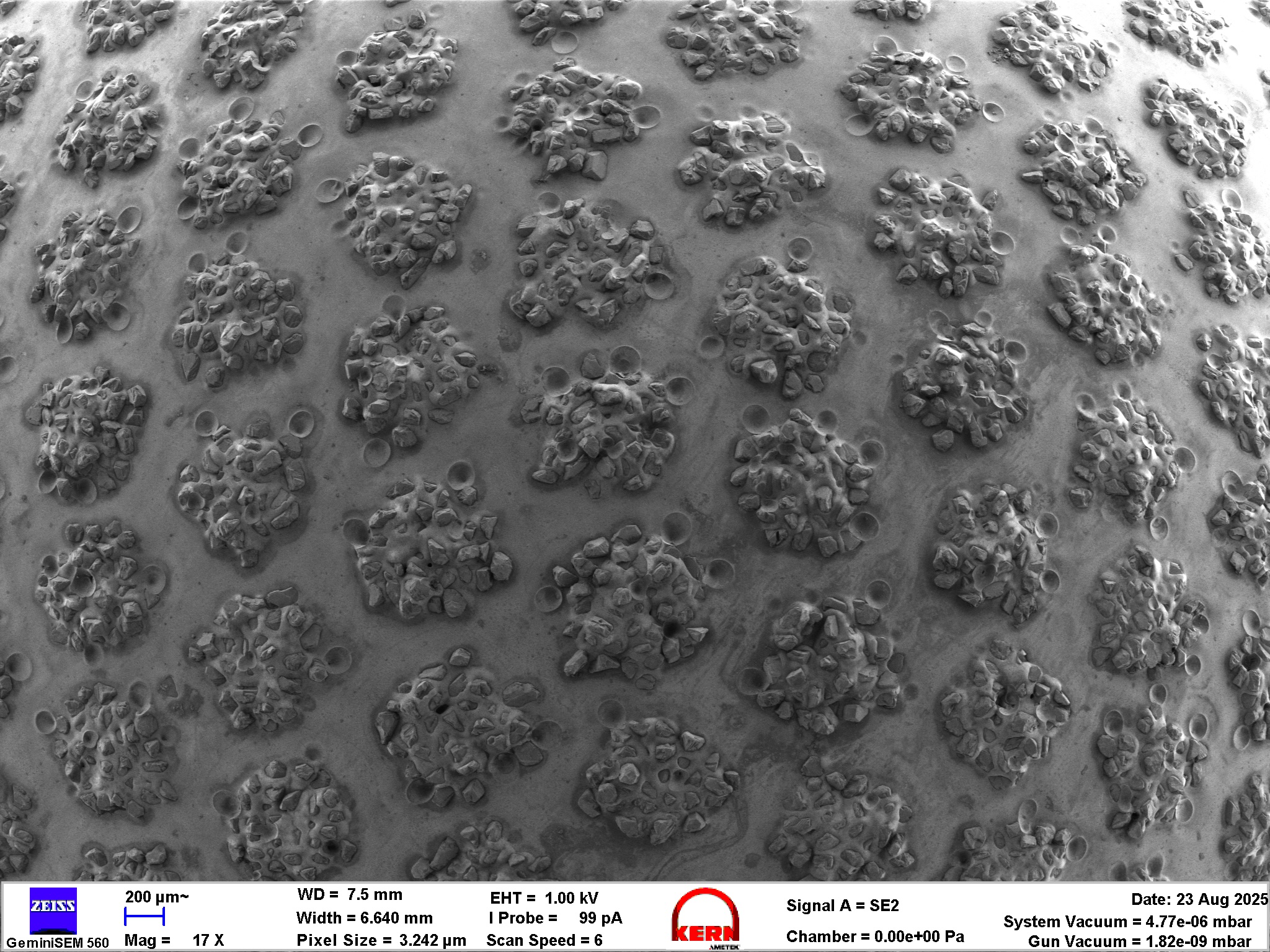
We can see a very regular distribution of diamonds. Remarkably enough, these “Piles” of diamonds are actually 3D shaped – I suspect multiple layers of diamond. How exciting!


SEM micrographs of the ATOMA F140 stone. Instrument: Zeiss GeminiSEM 560.
Moving in a bit closer, we can see that this is correct. The individual piles of the diamonds are several grains “high”, I would expect about 2-3 layers of diamond on this stone. This is very cool, as it will double or tripple the lifetime of this stone, making it better value than a single layer EP stone. The small dimples visible at the side of each pile are probably where the mask for the pattern had contact – or some airbubbles got caught.
Let’s look at the chemical composition! For this we are going to use an advanced SEM technique called EDS. If you want to know more about this, I’ve written extensively about SEM microanalysis here on this blog.


EDS analysis of the stone. Instrument: Oxford Ultim Max ∞ 40mm2 EDS sensor. Note that our EDS sensor doesn’t show elements lighter than boron.
EDS analysis shows a high tech bond, with quite a bit of Chromium in it. While not the most environmentally friendly nickel coating, this is a very strong and hard galvanic binder, much better than on any EP stone we have seen so far on the blog. A side note: a large portion of the general population is extremely allergic to nickel. If you experience rashes from using EP stones, this might be a reason.
In order to evaluate the sharpening performance and material removal mode of this stone, a blade was sharpened with it. I am using a standardised testing procedure, read about it here. Nevertheless, it’s 65 HRC M398, and sharpened to 17 DPS with resin bond diamond stones down to 10 µm. Afterwards, the tested stone is used, first in a back and forth movement until the surface becomes homogenous, and then alternating strokes (5-5-3-2) on each side, for a total of 20 strokes towards the apex per side. No pressure is applied but the weight of the apparatus.
The edge is then analysed in the electron microscope for breakouts and morphological appearance.


SEM micrographs of the edge finished with the Atoma F140 stone. Instrument: Thermo Fischer PhenomXL SEM.
The stone itself feels super coarse – much more so than the grit size would implicate. This is because the feedback (which is a very fancy jargon word for vibration and friction induced sensation) on this stone is dominated by the pattern on the stone, and not the actual grit size. It feels more like a file than a stone. Nevertheless, it is super quick cutting, and as we can see on the SEM – it does cut, and remove material. The surface is very coarse, rough and shows deep scratches. The apex is still very visible – as we can see at larger magnifications, quite a bit of pressure from the individual, large grains lead towards whole portions of the apex breaking off.


Optical micrographs of the edge finished with the Atoma F140 stone.
The optical micrographs highlight this even more – this is a very coarse stone. It’s pretty durable, and super fast. I think this is a fantastic method to rework a knife to a new angle, or make the initial bevel on a newly made knife. Overall, I loved this stone. This is my favourite EP stone so far, and has become a regular stone I use in my sharpening. Just…don’t stop at this stone! There’s finer ones 🙂
Sharpening disclaimer: I use a standardised approach to sharpening, which basically follows how most manufacturer of guided systems tell you to use this system. I am very aware, that every stone could perform much better than this, in terms of sharpness, but I want a comparable approach. The sharpening segment mostly shows the material removal mechanism – is it burnishing? is it cutting? is the cutting pressure too high so that carbides crack? Is there massive burr or prow formation? The BESS value definitely doesn’t highlight the ultimate sharpening performance of the stone, but was an often requested information. Over time, this blog will show BESS values for different edge morphologies, but by the holy endmill – don’t read it as a „this is the max value this stone can achieve“. I would also suggest to familiarise yourself with the works of Immanuel Kant, it’s absurd I need to write such a disclaimer here.
Leave a Reply