
This is part of a series of blog posts – looking into the appearance and composition of commercially available sharpening stones. If you are interested in the previous episodes, check out the archive for them.
If you have some suggestion on what I should look at next, or want to share your super secret DIY stones, I could be persuaded to open the bag of analytical devices… hit me up on Instagram under @marvgro for that.
Disclaimer: I’m not for sale. Every review you see on this blog is bought with my own money. I have no affiliation to any manufacturer.
Review
Today’s sharpening stone is the “large brother” of one we had on the blog before – namely the Poltava CBN 2.5 µm. That one didn’t really work at all, for a number of reasons – too little CBN, too hard bronze binder, and some contamination. An avid reader of mine suggested I get a coarser one – and this goes hand in hand with what I concluded in the review: I could see this being a good stone at a larger grit size! Spoiler: it is!
Let’s take a look under the optical microscope:

Optical micrographs of the stone. Instrument: Leica Emspira
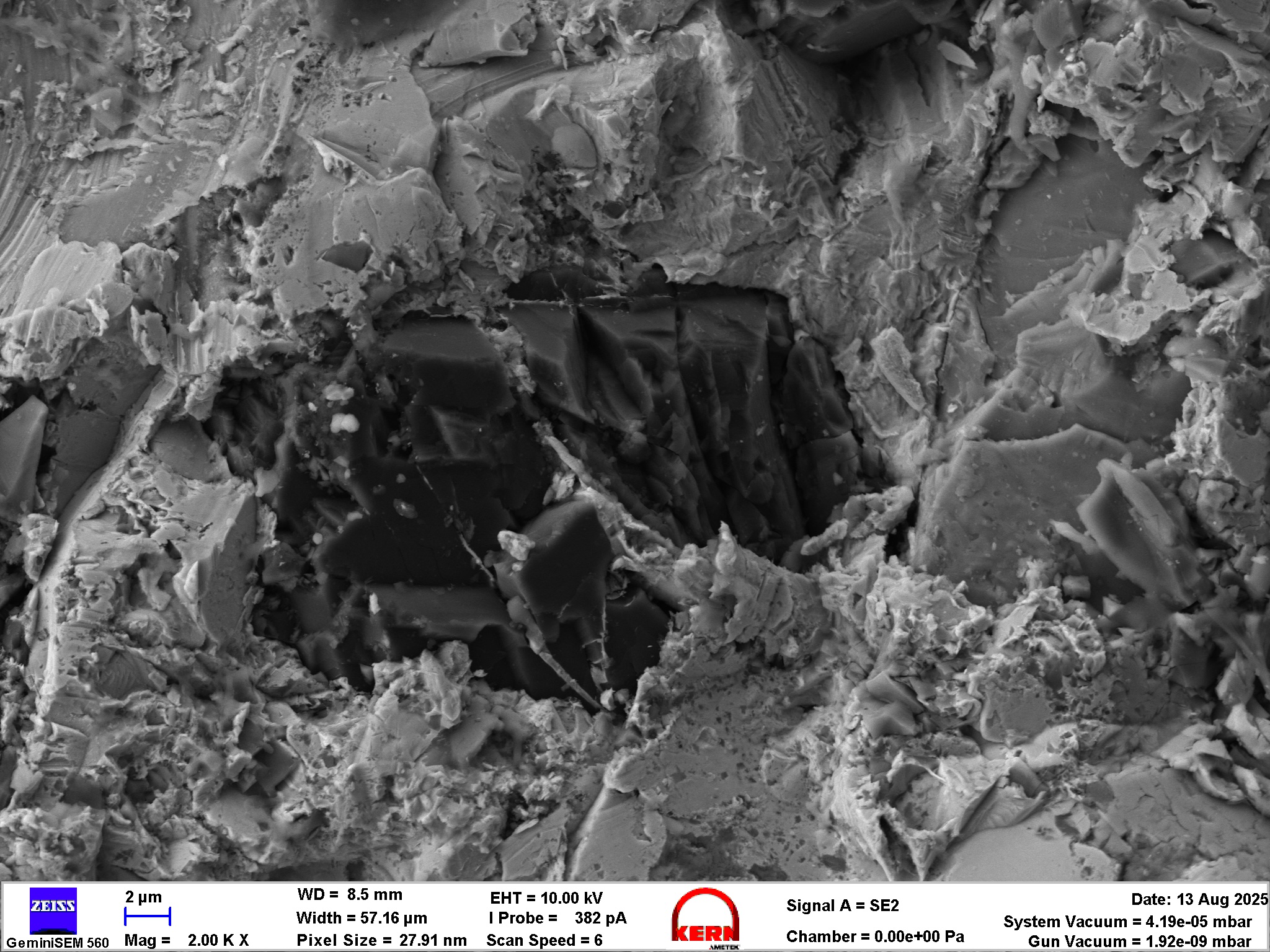
As usual, the bronze binder hides most of what we are looking for. But not to worry – this is the reason every stone get’s looked at under the SEM!


SEM micrographs of the stone. Instrument: Zeiss GeminiSEM 560.
We can see that a number of dark, abrasive particles is visible. These are well within the stated size of the manufacturer. I wouldn’t call this a high concentration, but there definitely is some grit in this stone!
Let’s look at the chemical composition! For this we are going to use an advanced SEM technique called EDS. If you want to know more about this, I’ve written extensively about SEM microanalysis here on this blog.


EDS analysis of the stone. Instrument: Oxford Ultim Max ∞ 40mm2 EDS sensor. Note that our EDS sensor doesn’t show elements lighter than boron.
Curiously enough, besides some SiC contamination, this stone also has some large titanium rich regions in it:


EDS analysis of the stone. Instrument: Oxford Ultim Max ∞ 40mm2 EDS sensor. Note that our EDS sensor doesn’t show elements lighter than boron.
I am unsure why it is in here. It will make the binder much harder locally. If you have any suggestion or idea why it is in here, and not a sign of bad abrasive hygiene, I would love to hear it!
In order to evaluate the sharpening performance and material removal mode of this stone, a blade was sharpened with it. I am using a standardised testing procedure, read about it here. Nevertheless, it’s 65 HRC M398, and sharpened to 17 DPS with resin bond diamond stones down to 10 µm. Afterwards, the tested stone is used, first in a back and forth movement until the surface becomes homogenous, and then alternating strokes (5-5-3-2) on each side, for a total of 20 strokes towards the apex per side. No pressure is applied but the weight of the apparatus.
The edge is then analysed in the electron microscope for breakouts and morphological appearance.


SEM micrographs of the edge finished with the stone. Instrument: Thermo Fischer PhenomXL SEM.
We can see that this stone leaves a very serrated cutting edge. This will give you an edge on a blade that immediately grabs onto whatever you are slicing, and will feel much sharper. I think for an outdoor or everyday knife, this would be a cool, if sadly matte looking edge. The unfortunate downside is quite the wide apex – this is even visible from the side. This would not be considered a keen cutting edge.
The stone itself felt decently sharp and quick – I am a bit spoiled by my own design resin stones, and in the factory condition tested here, this stone felt a bit slower. I would guess that by etching this one, the grains would have a larger overhang, and would remove more material, easier.


Optical micrographs of the sharpened blade. The serrations but also matte surface is nicely visible. Instrument: Leica Emspira
I think this is a decent stone. I personally do not want to dabble in etching stones with chemicals, but unlike the 2.5 µm CBN stone, I would call this a working stone with a good feedback. The result is a serrated edge. If this is what you are after, this would be a very good stone to buy!
Sharpening disclaimer: I use a standardised approach to sharpening, which basically follows how most manufacturer of guided systems tell you to use this system. I am very aware, that every stone could perform much better than this, in terms of sharpness, but I want a comparable approach. The sharpening segment mostly shows the material removal mechanism – is it burnishing? is it cutting? is the cutting pressure too high so that carbides crack? Is there massive burr or prow formation? The BESS value definitely doesn’t highlight the ultimate sharpening performance of the stone, but was an often requested information. Over time, this blog will show BESS values for different edge morphologies, but by the holy endmill – don’t read it as a „this is the max value this stone can achieve“. I would also suggest to familiarise yourself with the works of Immanuel Kant, it’s absurd I need to write such a disclaimer here.
Leave a Reply