
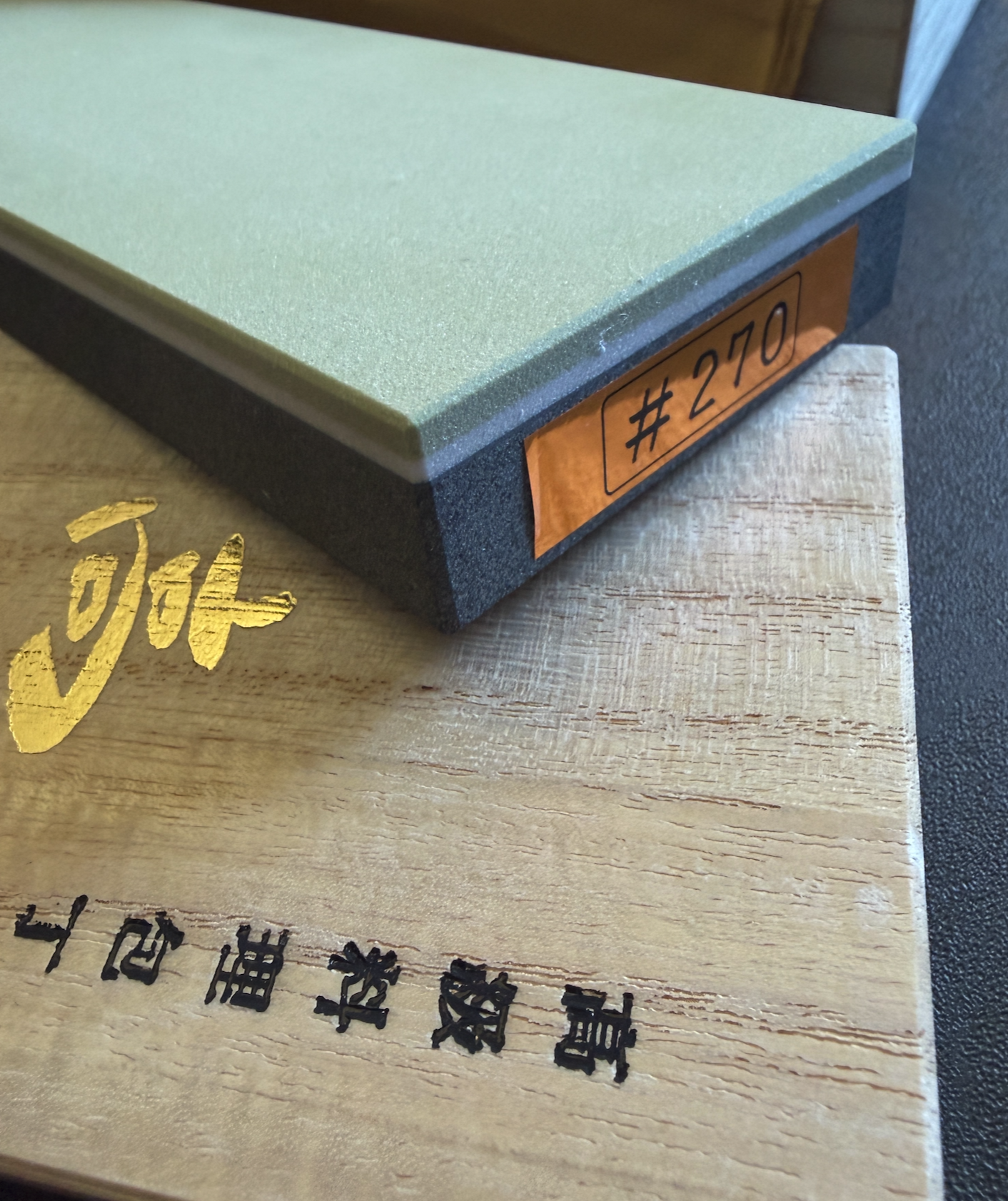
This is part of a series of blog posts – looking into the appearance and composition of commercially available sharpening stones. If you are interested in the previous episodes, check out the archive for them.
If you have some suggestion on what I should look at next, or want to share your super secret DIY stones, I could be persuaded to open the bag of analytical devices… hit me up on Instagram under @marvgro for that.
Disclaimer: I’m not for sale. Every review you see on this blog is bought with my own money. I have no affiliation to any manufacturer.
Review
Today’s sharpening stone is probably the most expensive to date. It’s the very special FSK Vitrified in their brand new #270 grit size. It’s meant to be the perfect benchstone for thinning a knife, but also setting the bevel. I only know of a single store that sells these regularly internationally – and had to import them from Japan through them. Many thanks to Miura Knives for selling these outside of Japan.
Let’s check it out!

Optical micrograph of the FSK vitrified stone. Instrument: MarvScope
The stone has quite the high diamond concentration. It’s my third FSK, and I was surprised by the amount of diamonds you can make out optically in this one. This is looking promising! Let’s dig deeper in the SEM.


SEM overview micrographs of the FSK vitrified stone. Instrument: Zeiss GeminiSEM 560.
The first impression is confirmed in the SEM – quite the high concentration of diamonds for a vitrified stone. One must not forget: FSK is an absolute high end manufacturer of abrasives, and I’d guess that the sharpening stones are just a point of pride for them, not a relevant percentage of the business.


SEM micrographs of the stone. Instrument: Zeiss GeminiSEM 560.
Zoomign in further, we find a dense marix in which the abrasive grains are sitting. The whole surface shows spherical marks of differing sizes. I’d guess that here some sintering / binding agent has transitioned into the gas phase and created the voids. This is not in itself a bad thing – it relieves some pressure by creating these voids. The diamonds themselves are well defined and of the more angular type. They sit recessed and well surrounded by the matrix. This is, already just optically, a very firm stone that will last for a long time.
Let’s look at the chemical composition! For this we are going to use an advanced SEM technique called EDS. If you want to know more about this, I’ve written extensively about SEM microanalysis here on this blog.


EDS analysis of the stone. Instrument: Oxford Ultim Max ∞ 40mm2 EDS sensor. Note that our EDS sensor doesn’t show elements lighter than boron.
We can find a typical vitrified bond here, but very pure – there are no additional grains but the diamond in it. From the chemical composition, I’d guess that this bond was sintered in a professional vacuum oven, with high hardness and strength as the result.
In order to evaluate the sharpening performance and material removal mode of this stone, a blade was sharpened with it. As this is a benchstone, I’m using a Katocut Nowi Pro to sharpen the blade and an exact angle and remove the human error. Two blades are sharpened – one is a custom heat treated M398 (65 HRC), one is a commercially available Nitro-V Blade (60 HRC), which shows the stones behaviour in two wonderful steels near the opposite ends of the spectrum of knife steels. The stone was used wet and regularly splashed with water.
The stone itself is very nice during use – it’s very hard, so there is no danger of cutting into it. It’s very homogeneous and quite flat. The blade gliding along it gives a lot of feedback (aka vibration) and because it is so hard it’s easy to determine the angle between bevel and blade. I know that these stones are hyped a lot in freehand sharpening, and I can definitely understand that. Material removal felt very slow to me – I would have expected a #270 grit diamond stone to be nearly a file, but instead a lot of passes were needed to sharpen this. By using a lot of pressure, more than I can use during sharpening, material removal sped up. Nevertheless, I can’t quite agree with the statement that this is the perfect blade thinning stone – it felt too cumbersome and slow to me for that.
The edge is then analysed in the electron microscope for breakouts and morphological appearance. Let’s start with the M398 blade:


SEM micrographs of the edge (M398) finished with the FSK vitrified stone. Instrument: Zeiss GeminiSEM 560
The stone left a surprisingly smooth surface. I would guess that this is because of the very hard matrix, and the deeply embedded diamonds. The matrix is hard enough to create a lot of pressure and burnish the surface to a light gloss. The apex is quite wide or unrefined here – it definitely is a coarse stone that is meant to remove material, not sharpen. There is very little deformation near the apex, but quite a bit of plastic smearing / burnishing can be made out along the bevel surface.
In NitroV, the stone performed quite a bit better:


SEM micrographs of the edge (NitroV) finished with the FSK vitrified stone. Instrument: Zeiss GeminiSEM 560
While the edge is more ragged, we also got a thinner apex. Nevertheless, the surface of the bevel is not as good as it was on the M398. I would guess that the hardness of the bond is enough to start cutting and ploughing through the much softer NitroV steel, this creating more micro prows and burrs that increase surface roughness on the bevel.
Overall, this was a surprising sharpening stone. The finish, packaging and presentation are wonderful. It feels like a very high quality product – which it is! If your style of sharpening involves a lot of pressure, I would imagine this is a good stone, as the bond is super firm and hard. I am not sure that such an approach to sharpening is ideal – to me, pressure control is of utmost importance, and I feel like this is a major issue with all vitrified stones – the bond is just to firm for hand guided sharpening. If you are looking for a fantastically crafted coarse benchstone with a lot of feedback, this is a decent choice. I’d love for it to have more bite / higher removal rate though!


Leave a Reply