Tag: metrology

  • Metrology Marvels – Part 1 – Introduction to scanning electron Microscopy

    Metrology Marvels – Part 1 – Introduction to scanning electron Microscopy

    This is part of an ongoing blog series about metrology. It explains physics, principles and use cases of modern metrology devices.

    TL;DR: Explains how a SEM works. Deep dive into the electron-beam interaction, showing how every sensor gives a different picture and what they could be used for. Lot’s of solid state physics, but in the fun “look at how amazing nature is” way, not in the “equations of horror and despair” way. This should be a fun read and easily understandable, even if you haven’t thought about physics since school.

    From the amount of scanning electron microscope (SEM) pictures in this blog, you can guess that I’m a huge fan and heavy user of these wonderful devices.

    Brief historical overview & resolution limit

    The basic idea behind a SEM is the Abbe diffraction limit of resolution. Ernst Abbe was a pretty cool dude – he lived in Germany during the late 19th century. He defined the foundations of modern optics, had a very impressive beard and is credited with owning Carl Zeiss for some time and the creation of Schott AG. In precision engineering, he has had a lasting impact, mostly for his definition of Abbe Error Compliance (Measurement device in axis of movement is more precise than parallel to axis), but also the Abbe diffraction limit.

    It basically states, that the minimum resolvable feature size d is a function of the wavelength of your radiation λ divided by 2 times the index of refraction of the immersed medium n (for example air) times the half-angle subtended by the objective lens θ. The numerical aperture NA describes the resolving power of a objective lens, and is the product of n * sin θ. Thus we have for our system resolution:

    d = λ / 2 NA

    If you have air between your objective lens and sample, NA can only ever be below 1. Very high quality, large magnification objective lenses can for example have 100x/NA 0.95, coming very close to this theoretical limit. This means, at absolute best, our smallest, resolvable feature is about half the wavelength of the radiation. If you have a nice, confocal microscope, your system might use a green LED at 532 nm, thus your systems resolving resolution is in the range of 0.25 µm. There’s a couple of techniques to get around this limitation, but with visible radiation, you are not going to get massive improvements in lateral resolution. But: the wavelength of radiation is inversely proportional to the energy of the radiation:

    E = h*f and: λ = c/f

    Visible light typically has an energy of 0.5 – 3 eV, a WLAN signal about 5 µeV. X-Rays start somewhere around 1 keV, and most SEM have their resolution sweet spot at 15-30 keV. Modern tunneling electron microscopes TEM are in the range of 200-300 keV. Sadly, we do not have a TEM at Kern Microtechnik GmbH. *chicken scratches one onto the “Dr.Marv purchase wishlist”*

    The first instrument that can be considered a SEM was build by the German Manfred von Ardenne in 1937. His patent is still online in the European patent space, and a wonderful read.

    Now, the actual resolution of a SEM isn’t as close to the theoretical limit as optical microscopy has, because it is surprisingly difficult to compensate all beam and lens (magnetic field) errors. Aberration error correction is something that is only now really hitting the market.

    Nevertheless, even a small, entry level desktop SEM like our Thermo Fischer PhenomXL spots a datasheet resolution of smaller than 10 nanometre. Typically, this is achieved as the distance between gold nanoparticles on carbon. Very conductive, maximum elemental contrast and clearly defined boundary edges. It goes without saying, that this is the easiest possible image for a SEM!

    SEM micrograph of a very dirty, hydrocarbon contaminated resolution test object. What you see is gold nanoparticles on carbon, at a very high magnification (500kX) and very low accelerating voltage (1 keV). Analysis has shown that our instrument is within specification, even here: 0.7 nm @1keV. Taken with the magnificent Zeiss GeminiSEM560.

    At lower energy, the electrons are also much slower, thus experiencing more extraneous influences such as magnetic stray fields or vibrations from body or acoustic noise. A high resolution SEM will have sub 1 nanometre resolution over the entire energy range.

    General working principle of a SEM

    We have defined that instead of using a beam of visible light, an electron microscope uses a beam of electrons to look at matter. At minimum, an electron microscope consists out of an electron source, some condenser, scanning and focusing “lenses” (which are actually coils with a magnetic field), an aperture, a vacuum chamber with the sample as well as a sensor to detect the signal.

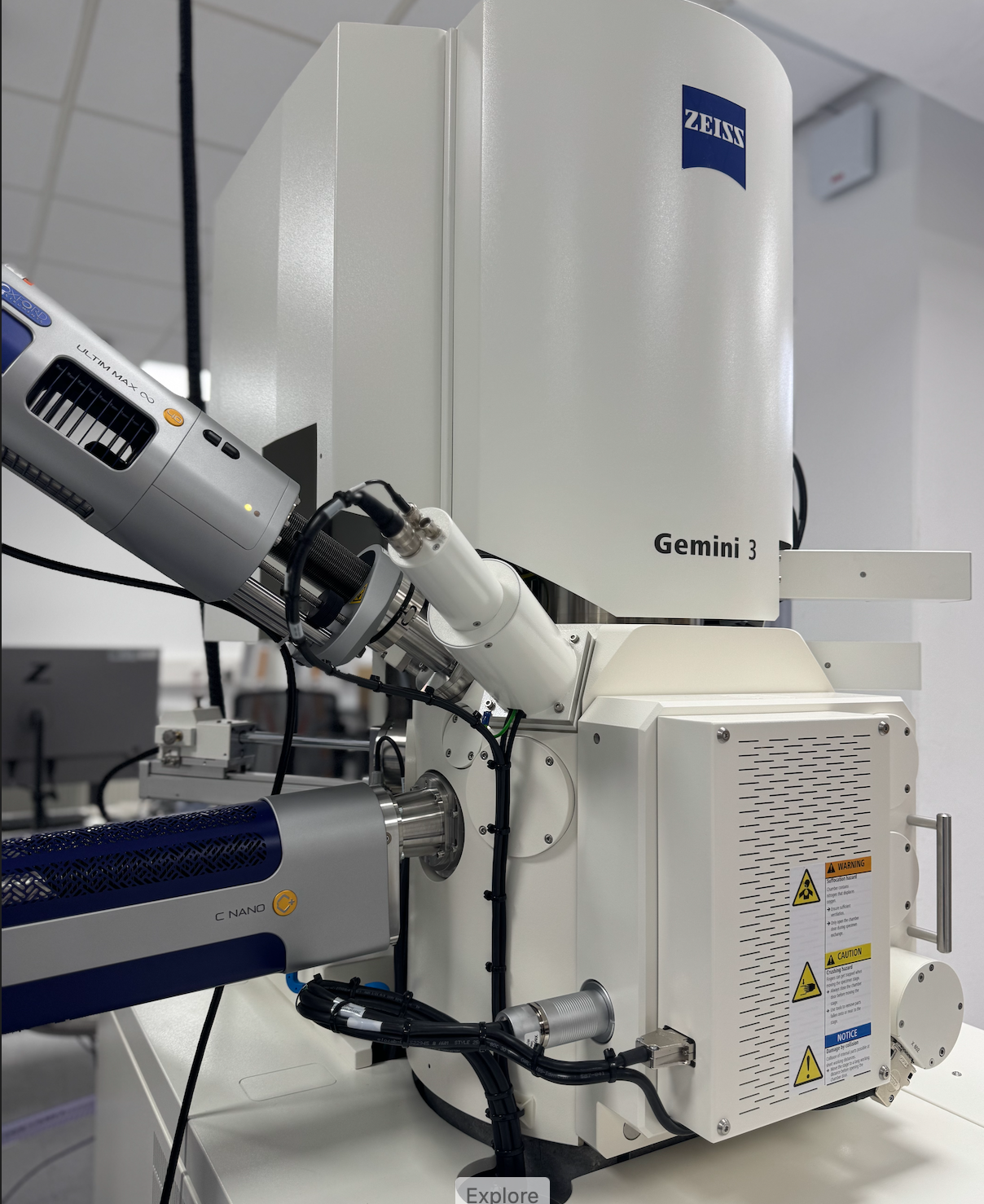
    Below is a schematic view of the column design of our ultra high resolution, Zeiss GeminiSEM560.

    Schematic cross section of a high resolution SEM column. Pictured detector is a SE2 Everhart Thornley type.

    At the electron source, electrons are generated. There’s two typical ways: thermionic emitters, where either a tungsten or a LaB6 filament is heated until free electrons are emitted. The second option is a field emission gun (FEG), where a small filament is heated, but the electrons are removed via a strong electric field. FEG are typically more stable, have less noise and a narrower energy spread. They are more expensive and set higher requirements to the vacuum system.

    The electron beam is then accelerated via an electric potential, and then shaped and focused via condenser lenses. The beam current is regulated via an aperture orifice. The beam is then focused and scanned across the sample in a regular pattern via the objective lens. This scanning is not a continuous process, but instead the beam dwells for a short amount of time at every “pixel” position. A detector simply counts the signal emission at every point, thus creating a black and white picture from the sample – electron beam interaction.

    It is a very basic principle, but the interaction of the beam and the sample is very complex, and many sensors exist to detect different types of signals. What is really nice about this scanning and way of detecting a picture compared to having a high resolution sensor with many pixels is that all sensors have the same focus point – so you can typically seamlessly switch between sensors and don’t have to refocus.

    Electron – Matter – Interaction

    In order to understand the different pictures and data created from a SEM, we need to take a quick detour towards high-energy electron beam interaction with matter. When matter is hit with fast electrons (the primary electrons, PE), a couple of possible interactions can happen. The below schematic shows the 4 dominant types, mainly back-scatter electrons (BSE), secondary electrons (SE, type 1 and 2) and x-ray emission (hv). The interaction volume depends on beam energy, but is typically in the range of < 10 nm for SE1, 1-50 nm for SE2, 50-1000 nm for BSE and 1-10 µm for hv. Because of scattering, the interaction volume is shaped a bit like a pear.

    Schematic beam interaction with matter. The 4 main emitted signals are shown: BSE, SE1, SE2 and hv.

    The interaction volume depends on beam energy, but is typically in the range of < 10 nm for SE1, 1-50 nm for SE2, 50-1000 nm for BSE and 1-10 µm for hv. Because of scattering, the interaction volume is shaped a bit like a pear. To show this interaction, I’ve prepared a small Monte-Carlo scattering simulation highlight this interaction volume, and how deep the different species might reach. This is for a high energy beam in a light material.

    Interaction volume of high energy electrons in a light material. SE are highlighted in green.

    We will have to dig a bit deeper into the creation of each of these, but also how they change the picture and what data and conclusions we can draw from them. For this, I’ve put a very used, nearly broken carbide end mill into the SEM.

    First/left picture: The used endmill, before being inserted into the SEM chamber. Second/Right picture: the inside of the chamber, with the visible polshoe, SE2 detector and illuminated chamberscope. A couple more complex sensors are visible in the background.

    After pumping the chamber empty of air, activating the SE2 sensor and focusing, we can generate an overview image of the tool. Because the SEM flares the field at the objective lens, we get a much larger FOV, but heavy distortions. This is mostly useful for navigating and finding a feature (or even: where the heck am I currently!).

    SE2 overview picture of the inserted endmill. Instrument: Zeiss GeminiSEM560

    Secondary Electrons

    Sometimes, when the incident electrons interact with an atom, they do so through inelastic scattering with the shell electrons. This ionises the electron, via ejecting a shell electron, the so called secondary electron. If it’s the primary electron, these SE are called SE1, and are very surface sensitive and detected via a SE detector inside the electron column. If it’s created by backscatter electrons ionising the atoms, they are called SE2 and are detected via an in-chamber detector. These are very sensitive to topography, so the resulting picture is a good representation of the shape and surface of the sample. Because they are created by BSE, the interaction volume is a bit deeper, and the signal can’t resolve very fine surface detail. This sensor is very susceptible to static charge up on the sample.

    Schematic depiction of the SE creation process. Note that the incident species can also be BSE, and not only SE.

    The SE2 sensor is very fast in it’s readout speed, and typically, especially at longer working distances (distance between the pole piece and the sample) exhibits a strong signal. If the sample is non-conductive, this is my first choice in focusing the picture and for navigating. Because it is at an angle inside the chamber, the sensor gives a very good depth representation of the sample. Pictures look plastic and 3 dimensional.

    SEM micrograph of the cutting edge. Signal A = sensor used, in this case the chamber SE2 type. The picture has depth, and nicely shows the morphology of the grinding marks, the coating and particles on the tool.

    Switching to the InLens SE1 detector, the picture changes in it’s appearance:

    SEM micrograph of the cutting edge. Signal A = sensor used, in this case the InLens SE1 type. The picture has lost some depth, but gained some detail on the surface structure. Besides the grinding marks, the micro-roughness of the coating is now visible.

    Because this sensor has a very small interaction volume, it shows fine surface details. Whereas the SE2 sensor mostly showed the grinding path along the tool cutting edge, this sensor shows the micro roughness of the coating, and highlights different sections of the build up edge through finer detail. At the same time, some depth perception is lost, resulting in a flatter picture.

    Back Scatter Electrons

    Back scatter electrons are created from elastic scattering (reflection) with the nucleus of the atoms. Because of this, the electrons have a lot of energy. The chance for elastic scattering depends on the mass of the nucleus, thus heavier elements give you a brighter signal. Therefore, the BSE signal gives you a material contrast.

    Schematic depiction of the SE creation process. Note that the incident species is either the PE, or a lower energy already back scattered BSE.

    The same cutting tool we looked at in the SEM can also be visualised with back scatter electrons. For this, our GeminiSEM560 is equipped with two different one: the ESB detector, that sits very high up in the column, and a retractable diode type 4 sector BSD sensor that can be fitted exactly below the pole piece.

    Because we can always activate it, let’s start with the ESB detector picture. We can see that the image is flattened a lot – this sensor is not really picking up any topography.

    In column ESB detector SEM micrograph of the cutting edge. Note the lighter coloured structures – these are heavier elements than the darker coloured structures.

    This sensor is quite “slow”, in the sense of it not getting a lot of signal. The above picture took a bit over 4 minutes to record.

    The SEM is fitted with a diode type, 4 sector BSE detector, that can be retracted and inserted via a pneumatic cylinder. Because it is sitting below the pole piece, it is much quicker, and still shows some surface structure.

    Chamber BSD SEM micrograph of the cutting edge. The picture has very little depth, showing only a minimal amount of surface structures. The BUE material is clearly distinguishable, showing 2 different materials via the inherent BSD material contrast.

    This sensor is much quicker, and shows some topographic details. A bit more depth perception than on the ESB sensor is given.

    X-Ray creation (EDS – Energy dispersive x-ray spectroscopy)

    The PE are able to create x-rays. I find this absolutely fascinating, and one of my favourite tools inside the SEM. When the PE interacts with the atomic shell, sometimes an electron is ejected (the SE). If this happens at a lower shell, a hole (missing electron spot) is created. Because most systems strive to lower their potential energy, a higher shell electron will then drop down. Because the new orbit has a lower radius, there is now some excess energy. Through this energy, just like Einstein foretold, a particle is created, specifically a x-ray photon. Because the distance between shells is dependent on the weight of the atomic core and it’s configuration (proton number), the energy difference is unique for every element.

    Schematic description of the x-ray creation process. An incident electron creates a hole in an inner shell through inelastic scattering (a SE is ejected). A higher shell electron drops down to fill the hole (blue arrow), because of energy conversion the lower orbit energy results in the creation of a x-ray photon.

    By recording lots of x-ray photons, and sorting them by their inherent energy, we can identify and map an elemental distribution over our picture. This process is called energy dispersive x-ray spectroscopy. It doesn’t tell you “This is REX 121 steel”, but instead after several minutes you can say “oh, we have about 12 % chromium in our sample. Maybe. I hope. Pinky promise!?”. This is the part where TV shows have ruined science for us scientists. But if done right, at correct readout sampling rates, high beam energy, you get fantastic results.

    What can we see on our tool edge? First and foremost the coating material – Ti, Al, N, Cr, resulting from a ceramic high tech multi layer coating applied to most modern tools. Build up edge and particles from aluminum, some stuck carbon, places where the coating has failed and tungsten carbide is visible through the coating. Pretty nifty, eh?

    EDS analysis of the tool edge.

    The real expertise in EDS is looking at the data and then making judgement calls and drawing from experience and know how. We once found a particle we wanted to analyse, and it contained bromine. People were stumped, because which part of the machine contains bromine? In the end it was the base of our powder coating, and the particle we found at a place it shouldn’t be was the powder coating from the machine enclosure that had flaked off. We managed to nail that down, because the only reasonable expectation of where bromine could be used was exactly that. Comparing a fresh piece revealed identical chemical composition.
  • A brief study on sharpening stones – Part 7 – Schleifjunkies Resinbond Stones (6- 3- 1 µm)

    A brief study on sharpening stones – Part 7 – Schleifjunkies Resinbond Stones (6- 3- 1 µm)

    This is part of a series of blog posts – looking into the appearance and composition of commercially available sharpening stones. If you are interested in the previous episodes:

    Part 1 is about the Fällkniven DC3 , Part 2 is about the DMT mini W7C, Part 3 is about the TSPROF Blitz F1000, Part 4 is about a natural jade stone, Part 5 is about the Venev 5/3 Diamond Resin Stone, Part 6 is about the Edge Pro Matrix Stone (4000 grit).

    If you have some suggestion on what I should look at next, or want to share your super secret DIY stones, I could be persuaded to open the bag of analytical devices… hit me up on Instagram under @marvgro for that.

    Review
    Today’s sharpening Stone is a triplet of stones. These are from a German sharpening shop called “Schleifjunkies”. The stones are advertised under the name “resinbond”, and according to the manufacturer create high gloss and super sharp edges in minutes, not hours. Ok! Let’s take a closer look 🙂

    The stones are well finished on the top surface, with a smooth, green surface. The side is raw and appears to be saw or maybe beam cut? They are actually glued down to the holder with some flexible foam tape, allowing for some flex between stone and aluminium holder:

    Let’s take a look at each stone under the optical microscope.

    Optical micrographs of the SJ Resinbond 6 µm stone. The scale bar is visible in the lower right corner. Instrument: Leica Emspira.

    Quite a bit of colour is visible at higher magnifications. Green, translucent green (typically diamond), black, and some reddish-orange colour. I think this is going to be a very interesting stone to look at under the SEM.

    Optical micrographs of the SJ Resinbond 3 µm stone. The scale bar is visible in the lower right corner. Instrument: Leica Emspira.

    Optical micrographs of the SJ Resinbond 1 µm stone. The scale bar is visible in the lower right corner. Instrument: Leica Emspira.

    The two finer stones show about the same colour – the translucent green particles do shrink in size though, most notably from 6 to 3 µm. I can’t really tell any difference in size on the other particles.

    The stone was cleaned with IPA in an ultrasonic bath, rinsed and then blow-dried with compressed, ultra pure nitrogen gas before getting put into the SEM.

    SEM Micrographs of the SJ resinbond 6 µm stone. Instrument: Zeiss GeminiSEM560.

    The stone is a mix of 3 different, easily identifiable grains. There are larger, above 10 µm grains all across the surface, in a low conecntration. there is a higher concentration of smaller, blocky, fractured grains as well as a notable amount of rounded grains, that have some molten look to them. Between the grains, some areas are binder (matrix / resin) dense, whereas others are dense agglomerations of grains.

    SEM Micrographs of the SJ resinbond 3 µm stone. Instrument: Zeiss GeminiSEM560.

    The 3 micrometre stone shows the wide spread of grains, and also their diverse size:

    There are some 10 µm sized grains, that are very long and narrow, interspersed with some more blocky, rounded grains that I suspect will be the diamond. On the upper left corner, one can make out the molten droplets in fine detail. These are also a bit lighter colour – typically a sign that they consist of a heavier element than the surroundings. I took a quick peak at the 1 micrometre stone, which looked nearly identical to the 3 micrometre one, but didn’t go through the trouble of recording the images, as I prefered to focus on finding out all it’s secrets – especially the 3 different grains that are visible! For this, I did energy dispersive x-ray spectroscopy (EDS) to create elemental composition maps over the SEM picture.

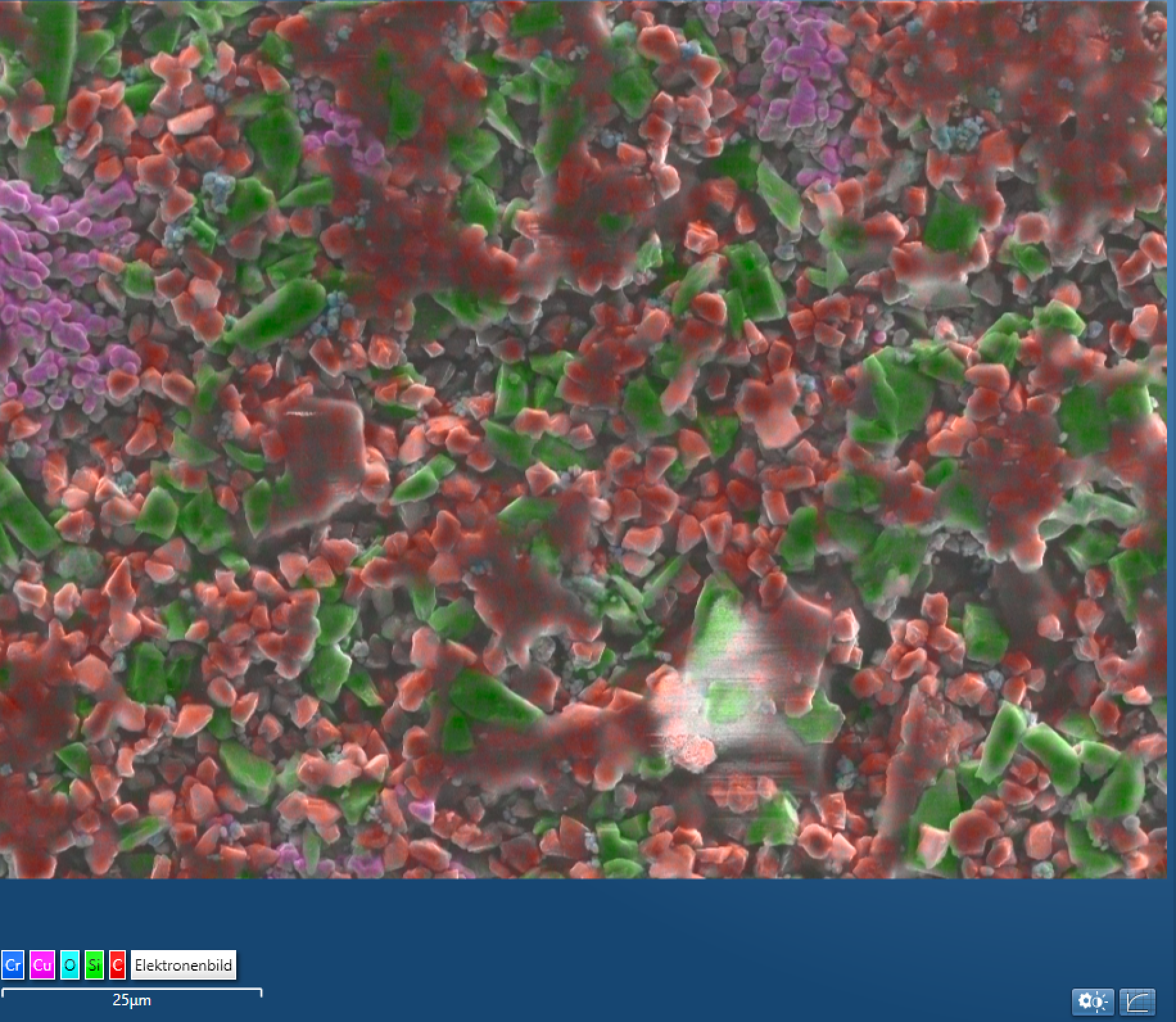
    EDS analysis of the Schleifjunkies 3 micrometre resinbond stone. Instrument: Oxford Ultim Max  ∞ 40mm2 EDS sensor. Note that our EDS sensor doesn’t show elements lighter than boron.

    The EDS analysis brings some clarity to this! Let’s take a closer look at the elemental mapping ,and what we can deduce from this.

    The stone has some large, blocky, molten looking red areas, which are carbon rich. This is the resin used to bond the particles together. The smaller, red grains are also mainly carbon – most definitely the diamond grain. SJ seems to have used a more blocky, smoother grain shape here.

    THe green grains are silicon, but by comparing the carbon intensity map, we can see that they also consist of carbon. This is silicon carbide, at about 3 times the size of the diamond grains. Silicon carbide is quite hard (2400-3000 HV, depending on the type), which is why it is often used as an abrasive on it’s own. The use in resin bond stones is typically to make the bond harder. The purple grains are actually copper – which explains the reddish grain we could make out in the optical microscope pictures. Copper is added to industrial resin grinding wheels to improve heat conductivity, and while this makes a lot of sense at high cutting speeds, and if your abrasive is alumina oxide (corundum) or SiC, diamond has a much better heat conductivity, and it’s the first time I’m seeing this on a diamond grinding bit. Frankly, here it can only be either a cheap filler, or the manufacturer took the same mix they use for AO grinding wheels and just added diamond. Trace amounts of chromium can be detected, as well as some oxygen, matching particles with the silicon map, so I’d suspect that the rare, white-ish particles we have seen in the microscope are SiO2 (quartz) particles.

    Let’s take a look at the surface roughness and appearance.

    3D height map of the 6 µm SJ resinbond stone. Instrument: Bruker Alicona µCMM, 50X objective lens, singe FOV high resolution focus variation scan. Data is leveled and outliers removed (0.25%). 2nd picture: area extract to show the grain.

    The surface, similar to the SEM picture, has large, very smooth sections, where the grain is still covered in a bit of resin, and also irregular, smaller sections with voids and recessed grains. This matches the view from the SEM quite well.

    ISO 25178 parameters of the 6 µm SJ resinbond stone.

    The stone surface roughness (Sq) is very low, with a nice and tight control on the height of the surface bearing material ratio (Sdc). The kurtosis (Sku) is quite high here, a result of the very flat sections in combination with the very steep walls leading down to the voids. This smooth stone will glide quite easily along a blade, while providing little feedback. The pressure applied is spread over a large area, reducing the force acting on every grain.

    3D height map of the 3 µm SJ resinbond stone. Instrument: Bruker Alicona µCMM, 50X objective lens, singe FOV high resolution focus variation scan. Data is leveled and outliers removed (0.25%). 2nd picture: area extract to show the grain. 3rd picture. ISO 25178 surface data.

    The 3 micrometre and 1 micrometre stone do not differ significantly in their surface parameters. I believe the surface of these stones is dominated by both the filler grains (SiC & copper), but also the breakouts above large nests of grains in combination with the dressing from the manufacturer.

    3D height map of the 1 µm SJ resinbond stone. Instrument: Bruker Alicona µCMM, 50X objective lens, singe FOV high resolution focus variation scan. Data is leveled and outliers removed (0.25%). 2nd picture: area extract to show the grain. 3rd picture. ISO 25178 surface data.

    The 1 micrometre resinbond stone has a line through the center of the height scan, sitting quite a bit above the rest of the surface area. Maybe a missed spot on the final dressing of the stone surface?

    In order to evaluate the sharpening performance of these stones, 3 blades were sharpened. In order to evaluate the sharpening performance of this stone, a blade was sharpened with it. I am using a standardised testing procedure, read about it here. Nevertheless, it’s 65 HRC M398, and sharpened to 17 DPS with resin bond diamond stones down to 10 µm. Afterwards, the tested stone is used, first in a back and forth movement until the surface becomes homogenous, and then alternating strokes (5-5-3-2) on each side, for a total of 20 strokes towards the apex per side. No pressure is applied but the weight of the apparatus. One blade was prepared with the 6 micrometre stone, the 2nd with first the 6 and then the 3 micrometre one, the last with all three stones.

    The 6 µm blade tested to a BESS rating of 135. No stropping was undertaken.

    SEM micrographs of the sharpened M398 blade. Finishing Stone: Schleifjunkies 6 µm. Instrument: Zeiss GeminiSEM560.

    The 6 µm blade shows a slightly wavy edge. Some burr is visible, as well as some carbide cracking from the grinding pressure. Periodically, deeper scratches are visible.

    The 3 µm blade tested to a BESS rating of 130. No stropping was undertaken.

    SEM micrographs of the sharpened M398 blade. Finishing Stone: Schleifjunkies 3 µm. Instrument: Zeiss GeminiSEM560.

    The 3 micrometre stone left a smoother surface with lower scratches. Near the apex, some cracking and a ghost burr are visible. Some deeper scratches are visible, similar to the 6 µm stone. The stone didn’t remove a lot of material, and mostly burnished the surface, which also explains why no significant sharpness improvement was visible.

    The 1 µm stone felt very dull. I spend more than 15 minutes just on that stone, with barely an improvement on the blade. Because of the low material removal rate, I raised the angle by 0.1°, so that the edge was leading and we could be sure that what we are later measuring was created by the 1 micrometre stone. The blade tested to a BESS rating of 160.

    Whenever I got a section to become smoother, a larger scratch appeared again. These deeper scratches are very similar to the other two stones. I would hazard a guess that it’s the SiC particles, which are similarly sized in all 3 stones.

    SEM micrographs of the sharpened M398 blade. Finishing Stone: Schleifjunkies 1 µm. Instrument: Zeiss GeminiSEM560.

    The blade got a bit smoother, but also rounded of the apex. The deeper scratches are very similar to the other two blades.

    Optical macro shots of the 6 / 3 / 1 micrometre finished blade. Instrument: iphone 15 pro max with a 120x optical loupe macro addon. Note the improved surface finish, but general appearance of larger scratches.

    I’m quite disappointed in these stones. I have two Schleifjunkies resin wheels for my Tormek T8, which do a better job. These stones feel to hard, with not enough of a bite. It feels like I am constantly burnishing the surface, and not removing a lot of material. The mediocre BESS tests and persistent scratches are of note here. I sharpened a much softer knife at 58 HRC with this, and had better results.

    The stones tested between 85 and 95 shore D at random locations. I took 5 measurements per stone. The measurements were taken at the sidewall of the stone.

    Sharpening disclaimer: I use a standardised approach to sharpening, which basically follows how most manufacturer of guided systems tell you to use this system. I am very aware, that every stone could perform much better than this, in terms of sharpness, but I want a comparable approach. The sharpening segment mostly shows the material removal mechanism – is it burnishing? is it cutting? is the cutting pressure too high so that carbides crack? Is there massive burr or prow formation? The BESS value definitely doesn’t highlight the ultimate sharpening performance of the stone, but was an often requested information. Over time, this blog will show BESS values for different edge morphologies, but by the holy endmill – don’t read it as a “this is the max value this stone can achieve”. I would also suggest to familiarise yourself with the works of Immanuel Kant, it’s absurd I need to write such a disclaimer here.

  • A brief study on sharpening stones – Part 1 – Fällkniven DC3

    The absurd amount on sharpening stones on the market should ring some alarm bells. The first is: there must be a lot of money in this. The second: what’s the difference between them? The third: which is the ideal one (for me)?

    I’ve ordered and then analysed a couple of different grinding stones. This is probably going to become an ongoing series of blog posts, whenever I get new and exciting grinding stones. If you have some suggestion on what I should look at next, or want to share your super secret DIY stones, I could be persuaded to open the bag of analytical devices… hit me up on Instagram under @marvgro for that.

    Fällkniven DC3 (diamond/ceramic whetstone)

    According to the manufacturer’s homepage, this is a “diamond grit 25 micron, sapphire ceramic grit 5 micron”. Let’s take a look!

    Optical Micrograph of the diamond side. Magnification and scale bar are visible on the lower right part of the image. Microscope: Leica Emspira

    The diamond side is coated in TiN. Typically, this coating can be found on cheaper HSS tooling, as it’s quite hard (2400-2700 HV), but also slick and doesn’t let chips adhere. It’s a curious choice to put on a grinding stone, as the grit used here (diamond) is quite a bit harder – depending on the grain orientation, it clocks in at 10000 HV. It’s certainly nice looking though, and I’d postulate that this is the main reason it is applied to any sharpening stone.

    SEM Micrographs of the Fällkniven DC3 stone. It shows quite a large range of grain sizes. Instrument: Thermo Fischer PhenomXL Scanning Electron Microscope

    SEM pictures show gritty, sharp diamonds. The range distribution of the visible grains (measured at their largest diagonal distance) ranges from 50 to 75 micrometre, with a strong weighting towards the upper end. The grit’s have a distinct checkered look to them – this is the coating, sticking to some parts of the diamond, and not adhering to others. It is very likely that the first use of the stone would remove the coating at any point that is in contact with a blade.

    Energy dispersive x-ray spectroscopy (EDS) inside the scanning electron microscope show the coating (Ti, N), the diamond grain (C) as well as the galvanic binder around the grains (Ni). Instrument: Thermo Fischer PhenomXL Scanning Electron Microscope

    In order to faciliate a better sense of depth and size, a surface scan was undertaken via white light interferometry. This creates a very high resolution height map – the Z resolution here is absurdly small, where’s the X/Y resolution (“spatial resolution”) follows the Abbe diffraction limited law.

    White light interferometry height map of the diamond surface. Instrument used: Zygo Nexview NX2, Objective Lens: 10X. Stitched overview of 4×4 images.

    We can see the typical galvanic bound height distribution – unevenly spaced grains with some very high outliers. This is the main reason that galvanic stones leave larger scratches and commonly a worse surface than a similar grain sized vitrified or resin bound stone.

    ISO 25178 surface parameters of the Fällknives DC3 diamond side.

    The ISO25178 parameters show a rough surface (Sa/Sq are the arithmetic respective quadratic surface roughness). Sz is the total height of the surface. Very indicative of the distribution is the parameter “Sdc”, which shows the range between the lowest 10% and highest 90% of the measured points. This is a good indicator how “even” the height distribution is. A perfect flat surface would have a value of 0 here, whereas a widely spread surface shows a wider range. It’s a usefull parameter to compare stones, but leaves out the 10% outliers at every end. Sku, the kurtosis shows how “sharp” the surface data is. Typically, a value below 3 is considered flat, whereas values above 3 are considered very sharp.

    The other “ceramic” side shows a typical ceramic abrasive mix.

    SEM images show a pretty uniform, surface with some large voids.

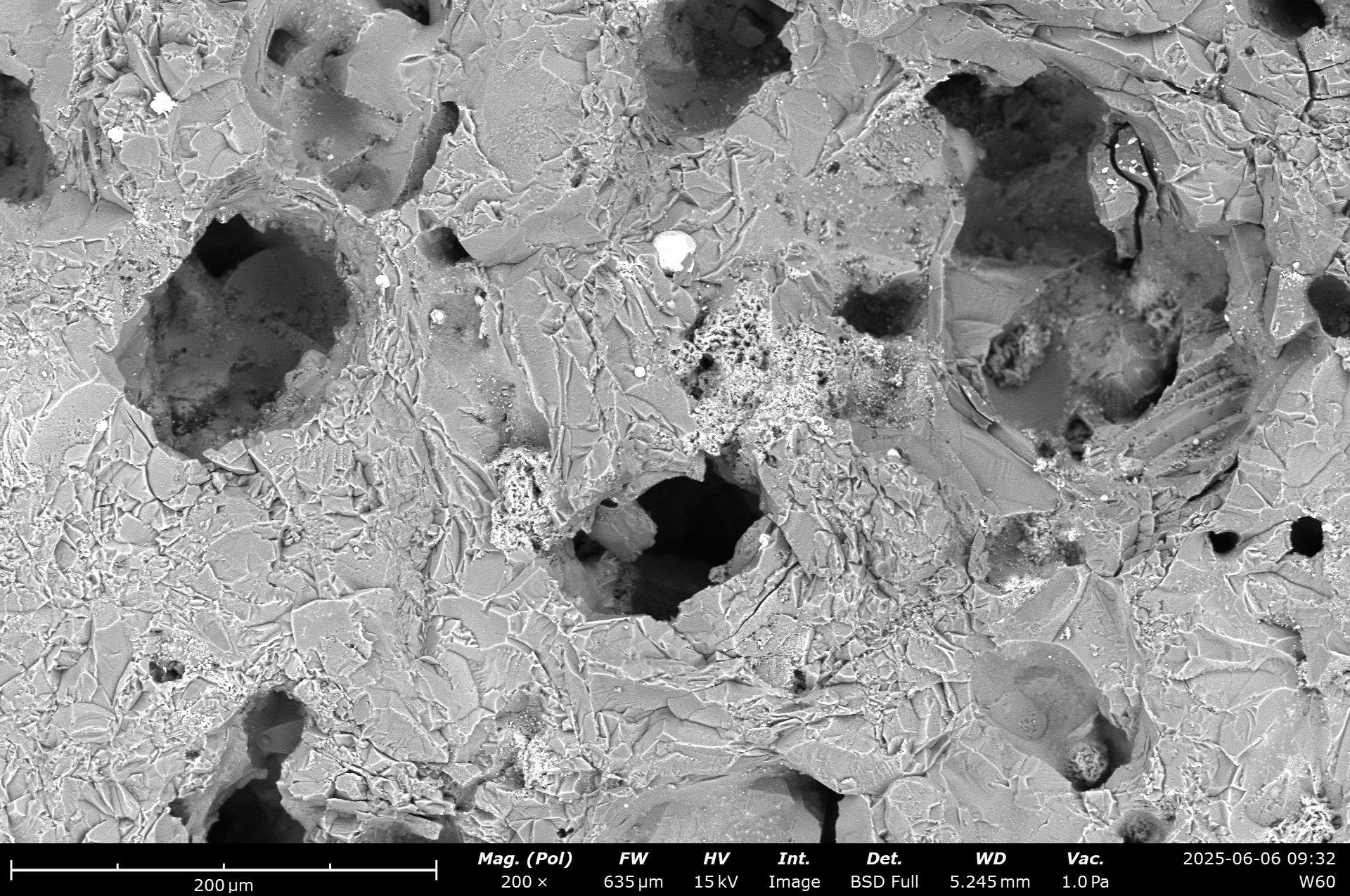
    SEM micrographs of the surface morphology. A typical, sintered alumina oxide appearance with some foreign particles (darker colour in the BSD image) and large voids are visible. Instrument: Thermo Fischer PhenomXL Scanning Electron Microscope

    While the void size is suprising, this certainly allows for some swarf build-up. 🙂 Some metal particles (bright white colour), but also some different abrasive grains (slightly darker grains) are visible. The detector used is a back-scatter detector. Here, besides the topographical contrast, one also has a contrast based on the weight of the element. The rule of thumb here is: the heavier the element, the brighter the returned pixel is. Pure metals are typically the brightest, whereas ceramics or diamonds are of darker colour.

    EDS analysis of the chemical composition. The colour corresponds to the individual element, visible above the scale bar. Instrument: Thermo Fischer PhenomXL Scanning Electron Microscope

    Chemical analysis show several large SiC grains, as well as Al2O3 grains. As sapphire is chemically Al2O3, just in a monocrystalline configuration, I think we have identified plenty about the compoistsion. Trace elements of metals and Calciumoxide (blue colours) are likely impurities from manufacturing.

    White light interferometry height map of the ceramic surface. Instrument used: Zygo Nexview NX2, Objective Lens: 10X. Stitched overview of 4×4 images.

    The whitelight interferometry surface map shows a relatively rough surface. large voids are visible, the range of height values doubles compared to the diamond size. On the other hand, the uppermost part of the surface shows a higher plateau region. The contact area likely is higher on this stone side. Sku, the kurtosis shows how “sharp” the surface data is. Typically, a value below 3 is considered flat, whereas values above 3 are considered very sharp. Here, a much lower value than on the diamond surface can be seen.

    Combined with the low sharpness of the dull ceramics, a burnishing effect is expected, improving the appearance of a blade with very low effort.

    ISO 25178 surface parameters of the Fällknives DC3 ceramic side.