
This is part of a series of blog posts – looking into the appearance and composition of commercially available sharpening stones. If you are interested in the previous episodes:
Part 1 is about the Fällkniven DC3 , Part 2 is about the DMT mini W7C,
Part 3 is about the TSPROF Blitz F1000, Part 4 is about a natural jade stone.
If you have some suggestion on what I should look at next, or want to share your super secret DIY stones, I could be persuaded to open the bag of analytical devices… hit me up on Instagram under @marvgro for that.
Today’s sharpening stone is an artifical, resin bound diamond stone. I believe these are sold under the TSPROF brand, but are made by Venev and are made by Venev, too. While it has two sides, for comparisons sake I only looked at the 5/3 micron side in detail. Why does it have two numbers here? Well, getting a very tight control on the grain size is expensive. Up to a certain size one can sieve it, and there you’d obviously have a spread of sizes (basically: everything that was smaller than the last sieve you used, but larger than the current sieve you are using). At a certain grit size though, this process is replaced by sedimentation. You basically dump your diamond powder that is created by crushing larger diamonds against each other into a tank with water, stir it vigorously and then leave it standing. Heavier particles sink to the bottom quicker than lighter ones, so you then suction it off layer by layer. The more careful and skilled one is at this process, the tighter the size distribution is. Typically, asia-sourced diamond is pretty good at this. Nevertheless, 5/3 is a very honest way of describing it. In Germany, tightly controlled (and lab analysed & certified!) diamond powder is readily available, but about 20 times more expensive than foreign sourced one. We should therefore expect to have a wide range of different grain sizes in this stone.
Taking a look under the optical microscope, a mix between reflective grains, darker but also green grains and a reddish matrix is easily identifiable.


Optical micrographs of the Venev double sided 5/3 micron diamond stone. The scale bar is visible in the lower right corner. Instrument: Leica Emspira.
It would be quite interesting to see what grains are diamond, what the other ones are (or if all are diamond!) but also what the surface microstructure looks like. For this, the scanning electron microscope is king. The resolution and depth of focus is just so nice. As this is a 1″x6″ stone, off it goes into our fantastic Zeiss GeminiSEM560. Absolute overkill, but it fits, so we here we go:


SEM Micrographs of the surface morphology of the Venev 5/3 micron diamond stone. Instrument: Zeiss GeminiSEM560.
The manufacturer says that they are using an organic bond, based on phenol-formaldehyde resins. These are typically improved by adding various fillers to them, for example SiC (to make it harder), copper (to improve heat transfer), but also organic material such as woodchips or fabric fibre to improve tensile strength. Information from the manufacturer about this is a bit inconclusive – apparently, they have a “B2-01” bond, that has fillers, and an improved “OSB” bond, that should not have “boron carbide” in it. Apparently the finer stones, such as this one, have the improved bond. What I find curious at this point is that the above SEM pictures show a large variance of grains – some, that would fit in the 5/3 micrometre range, but others that are much larger, and of a lighter colour. The SEM is special in terms of microscopes, in that every picture not only contains topographical information (e.g. the surface appearance), but depending on the sensor also some chemical information. The sensor used for the pictures above is the “SE2” sensor, which detects secondary electrons. These are created in the beam-matter interaction by basically hitting an electron on the atom-shell, and shooting it out. It is a very surface sensitive detector, mostly showing topography. Nevertheless, if you have much heavier elements, you get a very slight elemental contrast. The large grains are slightly lighter grey than the smaller grains, which could point towards them consisting out of heavier elements, for example SiC instead of C which would be found in pure diamond.
Fortunately, the SEM is equipped with a sensor to identify elements.

EDS analysis of the Venev 5/3 micron diamond stone. Instrument: Oxford Ultim Max ∞ 40mm2 EDS sensor. Note that our EDS sensor doesn’t show elements lighter than boron.
As postulated above, the abrasive in this stone consists out of some large, 10-15 micrometre sized silicon carbide (SiC, pink colour) grains, but also some agglomerated magnesium-oxide particles (MgO, green colour). The diamond grain concentration looks to be about C100 (equaling 25% by volume, but the standard is pretty vague on how and when this is determined). Nevertheless, I’m a bit disappointed by the mixing here – it seems like we have several agglomerated nests of diamond, with some spare grains in between. Also, I would imagine one will have quite the large scratches from the large SiC particles. SiC typically reaches a hardness of 2500-3000 HV, much harder than a decent powder metallurgical steel would achieve (64 HRC are around 800 HV, CBN is at 4000-5000 HV, diamond at 10000 HV in it’s hard crystallographic orientation). MgO meanwhile comes in at 1200 HV. In subtractive manufacturing, the typical rule of thumb is: your abrasive should be 5 times harder than the workpiece. Otherwise, you will have excessive wear on it. The binder clearly is organic in origin, a phenol based one seems likely by the appearance and “brittleness” of it. If you ask me, this was baked at a bit too high of a temperature, and with not enough pressure. This could explain the “debris type” dusting on it, as well as the large voids.
Taking the stone for a look under the white light interferometer, we can see the surface structure is very regular, but also quite coarse.

White light interferometry height map of the Venev 5/3 micron sized stone. Instrument: Zygo Nexview NX2, Objective Lens: 10X. Stitched overview of 5×5 images.
I could imagine that the deep pits we are seeing are actually foaming of the phenol-resin during the curing process, and not just tear outs from the dressing process, as I haven’t identified any particles this large. Nevertheless, if you compare it with the SEM picture of the large, molten agglomeration of binder, it could also be that these are distributed all along the stone, and we see the result of these tearing out.

ISO 25178 parameters of the Venev 5/3 micron diamond stone.
The stone is actually, and quite surprisingly, very coarse in it’s surface. I would have expected a stone with this fine grit to have a fine, polishing surface. The roughness is actually much higher than on for example the natural jade stone we looked at the last time. Nevertheless, the shape of the surface in itself can’t be considered very sharp, as for example the Kurtosis (Sku) is only slightly above 3.
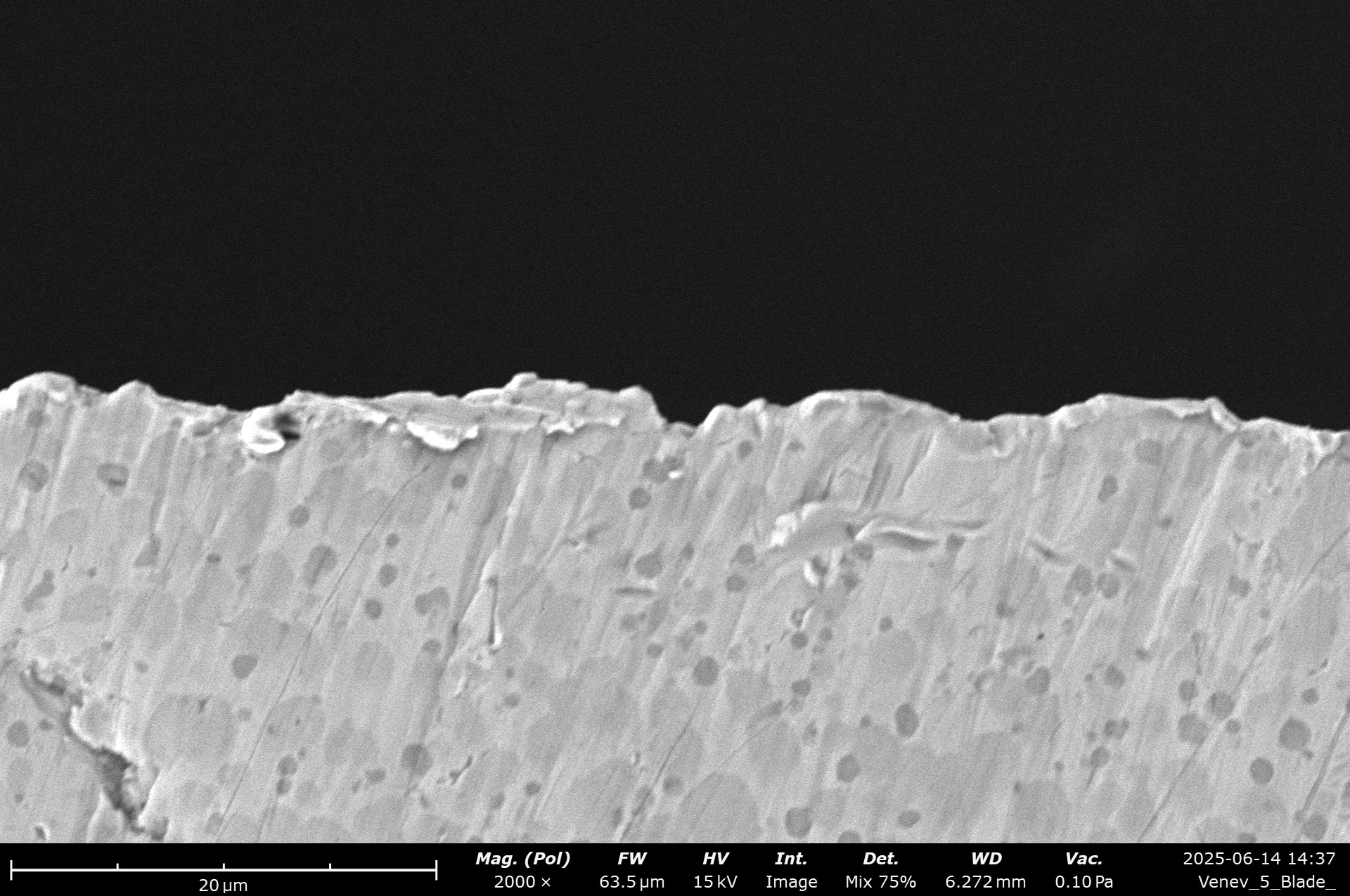
Seeing as this is an interesting stone for sharpening, I’ve taken the trouble of sharpening a blade with this. In order to evaluate the sharpening performance of these stones, 3 blades were sharpened. In order to evaluate the sharpening performance of this stone, a blade was sharpened with it. I am using a standardised testing procedure, read about it here. Nevertheless, it’s 65 HRC M398, and sharpened to 17 DPS with resin bond diamond stones down to 10 µm. Afterwards, the tested stone is used, first in a back and forth movement until the surface becomes homogenous, and then alternating strokes (5-5-3-2) on each side, for a total of 20 strokes towards the apex per side. No pressure is applied but the weight of the apparatus. Then the Venev stone was used.


SEM micrographs of a test blade, done with the Venev stone. Note the beautiful distribution of carbides in the M398. Boehler and Mr. Kasé are magicians! Instrument: Thermo Fischer Phenom XL Scanning Electron Microscope.
The result is a keen edge, with burrs that are already very hard to detect under an optical microscope. The largest burr I found was in the low, single digit micrometre range. Nevertheless, there’s some heavier scratches, and the cutting edge is slightly wavy. Comparing the deeper pits at the edge, I don’t think it’s massive carbide cracking, as those are a bit larger than the very fine carbides. I would imagine this is most likely the larger SiC grains, grinding away the edge. A pity!
Leave a Reply