Author: Dr Marv

  • A brief study on sharpening stones – Part 56 – FSK Vitrified #270 (Diamond, Vitrified)

    A brief study on sharpening stones – Part 56 – FSK Vitrified #270 (Diamond, Vitrified)

    This is part of a series of blog posts – looking into the appearance and composition of commercially available sharpening stones. If you are interested in the previous episodes, check out the archive for them.

    If you have some suggestion on what I should look at next, or want to share your super secret DIY stones, I could be persuaded to open the bag of analytical devices… hit me up on Instagram under @marvgro for that.

    Disclaimer: I’m not for sale. Every review you see on this blog is bought with my own money. I have no affiliation to any manufacturer.

    Review

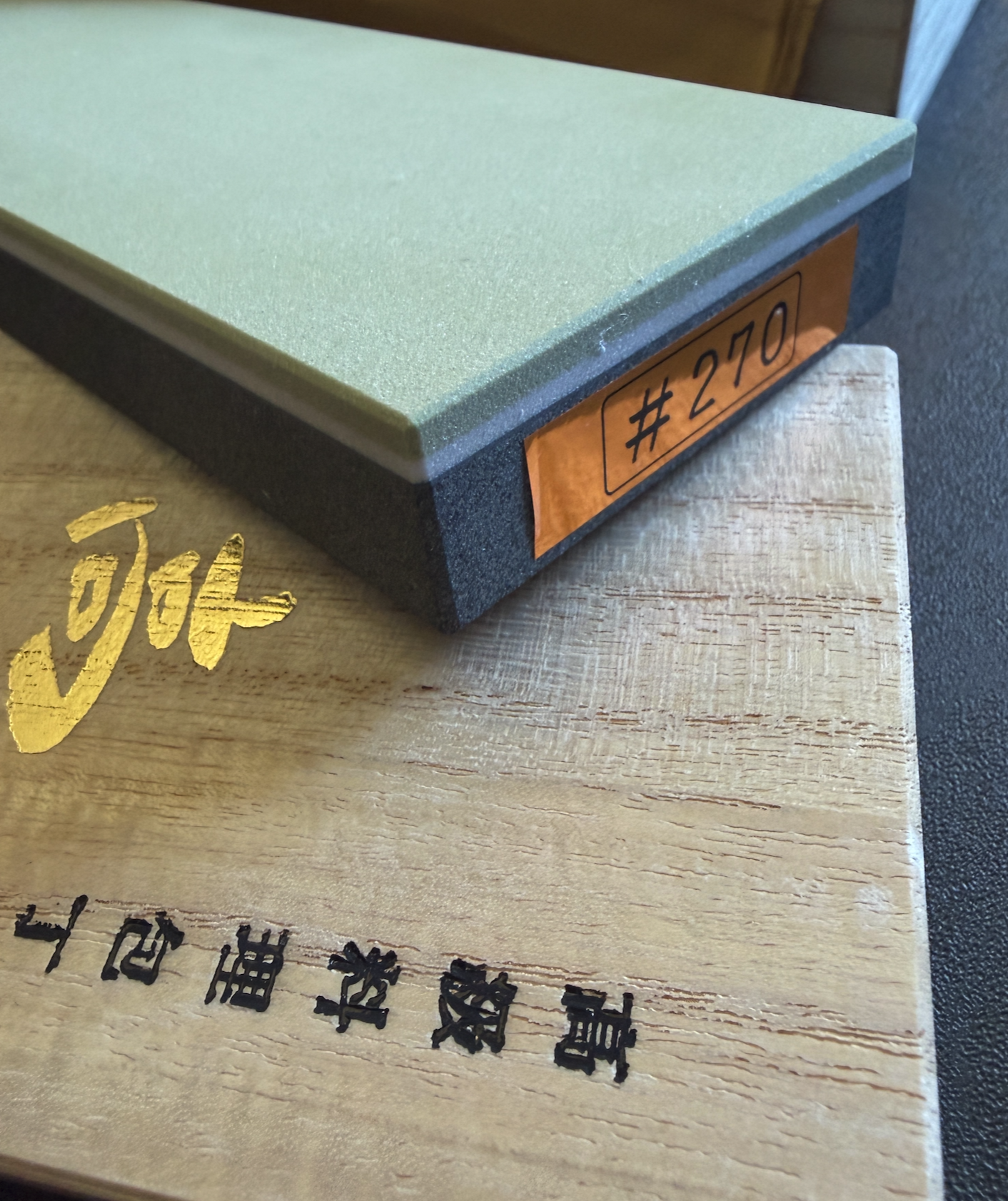
    Today’s sharpening stone is probably the most expensive to date. It’s the very special FSK Vitrified in their brand new #270 grit size. It’s meant to be the perfect benchstone for thinning a knife, but also setting the bevel. I only know of a single store that sells these regularly internationally – and had to import them from Japan through them. Many thanks to Miura Knives for selling these outside of Japan.

    Let’s check it out!

    Optical micrograph of the FSK vitrified stone. Instrument: MarvScope

    The stone has quite the high diamond concentration. It’s my third FSK, and I was surprised by the amount of diamonds you can make out optically in this one. This is looking promising! Let’s dig deeper in the SEM.

    SEM overview micrographs of the FSK vitrified stone. Instrument: Zeiss GeminiSEM 560.

    The first impression is confirmed in the SEM – quite the high concentration of diamonds for a vitrified stone. One must not forget: FSK is an absolute high end manufacturer of abrasives, and I’d guess that the sharpening stones are just a point of pride for them, not a relevant percentage of the business.

    SEM micrographs of the stone. Instrument: Zeiss GeminiSEM 560.

    Zoomign in further, we find a dense marix in which the abrasive grains are sitting. The whole surface shows spherical marks of differing sizes. I’d guess that here some sintering / binding agent has transitioned into the gas phase and created the voids. This is not in itself a bad thing – it relieves some pressure by creating these voids. The diamonds themselves are well defined and of the more angular type. They sit recessed and well surrounded by the matrix. This is, already just optically, a very firm stone that will last for a long time.

    Let’s look at the chemical composition! For this we are going to use an advanced SEM technique called EDS. If you want to know more about this, I’ve written extensively about SEM microanalysis here on this blog.

    EDS analysis of the stone. Instrument: Oxford Ultim Max  ∞ 40mm2 EDS sensor. Note that our EDS sensor doesn’t show elements lighter than boron.

    We can find a typical vitrified bond here, but very pure – there are no additional grains but the diamond in it. From the chemical composition, I’d guess that this bond was sintered in a professional vacuum oven, with high hardness and strength as the result.

    In order to evaluate the sharpening performance and material removal mode of this stone, a blade was sharpened with it. As this is a benchstone, I’m using a Katocut Nowi Pro to sharpen the blade and an exact angle and remove the human error. Two blades are sharpened – one is a custom heat treated M398 (65 HRC), one is a commercially available Nitro-V Blade (60 HRC), which shows the stones behaviour in two wonderful steels near the opposite ends of the spectrum of knife steels. The stone was used wet and regularly splashed with water.

    The stone itself is very nice during use – it’s very hard, so there is no danger of cutting into it. It’s very homogeneous and quite flat. The blade gliding along it gives a lot of feedback (aka vibration) and because it is so hard it’s easy to determine the angle between bevel and blade. I know that these stones are hyped a lot in freehand sharpening, and I can definitely understand that. Material removal felt very slow to me – I would have expected a #270 grit diamond stone to be nearly a file, but instead a lot of passes were needed to sharpen this. By using a lot of pressure, more than I can use during sharpening, material removal sped up. Nevertheless, I can’t quite agree with the statement that this is the perfect blade thinning stone – it felt too cumbersome and slow to me for that.

    The edge is then analysed in the electron microscope for breakouts and morphological appearance. Let’s start with the M398 blade:

    SEM micrographs of the edge (M398) finished with the FSK vitrified stone. Instrument: Zeiss GeminiSEM 560

    The stone left a surprisingly smooth surface. I would guess that this is because of the very hard matrix, and the deeply embedded diamonds. The matrix is hard enough to create a lot of pressure and burnish the surface to a light gloss. The apex is quite wide or unrefined here – it definitely is a coarse stone that is meant to remove material, not sharpen. There is very little deformation near the apex, but quite a bit of plastic smearing / burnishing can be made out along the bevel surface.

    In NitroV, the stone performed quite a bit better:

    SEM micrographs of the edge (NitroV) finished with the FSK vitrified stone. Instrument: Zeiss GeminiSEM 560

    While the edge is more ragged, we also got a thinner apex. Nevertheless, the surface of the bevel is not as good as it was on the M398. I would guess that the hardness of the bond is enough to start cutting and ploughing through the much softer NitroV steel, this creating more micro prows and burrs that increase surface roughness on the bevel.

    Overall, this was a surprising sharpening stone. The finish, packaging and presentation are wonderful. It feels like a very high quality product – which it is! If your style of sharpening involves a lot of pressure, I would imagine this is a good stone, as the bond is super firm and hard. I am not sure that such an approach to sharpening is ideal – to me, pressure control is of utmost importance, and I feel like this is a major issue with all vitrified stones – the bond is just to firm for hand guided sharpening. If you are looking for a fantastically crafted coarse benchstone with a lot of feedback, this is a decent choice. I’d love for it to have more bite / higher removal rate though!

  • A brief study on sharpening stones – Part 55 – Jende Nanocloth (Strop, Artificial)

    This is part of a series of blog posts – looking into the appearance and composition of commercially available sharpening stones. If you are interested in the previous episodes, check out the archive for them.

    If you have some suggestion on what I should look at next, or want to share your super secret DIY stones, I could be persuaded to open the bag of analytical devices… hit me up on Instagram under @marvgro for that.

    Disclaimer: I’m not for sale. Every review you see on this blog is bought with my own money. I have no affiliation to any manufacturer.

    Review

    Today’s sharpening stone review is a “mini” one – and it’s only looking (doing microscopy!) at the carrier of abrasives, namely the Jende nanocloth. It’s an artificial strop, and when I first read about them, I was wondering what these would be like. It’s a mini review, as I won’t use it to sharpen or strop an edge – maybe in a future episode of the stropping series.

    The strop comes on the Jende-typical brushed finish steel blank, where it sits on a thick polymer base. This gives the whole strop quite a bit of weight – I’m unsure whether that’s a good decision for a flexible strop! The actual nanocloth is quite thin:

    Let’s take a closer look under the microscope. The lower frequency of posting these past two months is twofold – I’m very busy with development, but also wanted to upgrade my optical microscopy. I went down the “DIY” route, and probably spend more than I should have, and also more than I probably would have paid for an upgrade over our Leica Emspira. Ah well! Feast your eyes on high resolution optical images:

    Optical micrographs of the Jende Nanocloth. Instrument: Dr. Marv-Scope

    We can make out a very regular, high porosity material. It exhibits a dense matrix around some pores – the pores themselves are very evenly spaced.

    Let’s take a look under the SEM:

    SEM micrographs of the stone. Instrument: Zeiss GeminiSEM 560.

    The view under the SEM is similar – we can make out cylindrical, very straight recesses that go quite deep! I’ll have to revisit this once I coat it with diamond emulsion. Seeing how the voids are > 30 µm in diameter, I wonder what will happen to diamonds – will they just accumulate inside these voids, or also sit on the polymer matrix?

  • Sharpening Mechanisms – Part 3 – KMFS Sensei

    This is the second instalment of a new blog series, where I try out sharpening mechanisms. I’m not yet fully sure about the format – I will write about things that matter to me, such as build quality, capability to sharpen, but also very subjective things like how it feels to sharpen with this. If I was you, I would expect this to be a rare blog segment. The reviews will be independent from the manufacturer, without control over what I test or write. I am not paid nor do I receive anything from the manufacturer if you decide to buy one.

    If you make a sharpening device and you want me to test it, feel free to reach out.

    KMFS Sensei

    Today’s sharpening mechanism is made by the Czech Company KMFS. In the last review, we had their 1×6″ mechanism – this time it’s the device meant to aid you with benchstones!

    At the time of this review, the mechanism retails for about 500 Euro. The device was a loaner unit given to me by the manufacturer, but they had no control over this review and didn’t see it before it was uploaded publicly.

    A close-up of a precision metal tool with adjustable components, including a clamp and rods, set against a dark background.

    The KMFS Sensei, assembled with the infinity angle adjuster.

    The device gets delivered in a custom foam cutout, very sturdy yet compact case:

    A KMFS sharpener kit displayed in an open protective case, featuring sharpening tools and accessories on padded foam.

    It assembles in just seconds – pretty much the only thing you have to do is put in one single screw to secure the base to the vertical stand. The case has enough space so one could fit some sharpening stones in there – making it a very mobile setup.

    Build Quality

    Let’s take a look around it:

    The device is clearly a vantaedge – silver metal parts, milled finishes, a combination of steel and aluminium. It is quite compact – barely longer than the 200 mm benchstone. The guiderails are from steel, the bearings are easy to move and the whole device has a heavy, solid feel to it. Because the lever from the swinging guiderail gets quite large, there are some detacheable little feet (visible close to the vertical rod at the back), that just “clip” in. Overall, the whole device is very quickly assembled.

    I think it’s a good look for the device, very fitting. A black edition would be superb though, especially together with the brass nut!

    KMFS is a European company located in the Czech Republic and manufactures, as far as I know, the parts themselves. This is something I can highly appreciate – kudos, KMFS!

    The Sensei came out relatively recently, and you can see that the manufacturer is trying to keep not only a style, but also some shared parts. The loaner unit I have comes with the new “infinity” adjustable angle mechanism:

    Detail photos of the infinity adjustable mechanism.

    The infinity adjuster is pretty cool: A thumbscrew drives a little gear that changes the angle. There is a rough indicator in the back, but the exact angle is set best via a small, digital angle cube. The knife is held very securely by two strong magnets that have a rubber cover. Everything is screwed together and should be user replaceable – for example, if worn out. Moreover, this allows for upgrading the device – my understand is, it typically comes with a couple of pre-set angles, and the infinity adjustable mechanism is an addon. I would imagine the manufacturer will come out with more possible addons, maybe a clamp, in the future, so it’s nice that it’s not pressed/glued together.

    The mechanism itself is self-locking – which is pretty neat in itself, as it does not require to tighten something. Nevertheless, there is a slight amount of play/backlash in the whole gear system, which you can make out near the end of the video. I think this is acceptable – after all, gravity preloads the system!

    The device as something really cool in the base – basically, the whole base is the sharpening stone clamping utility. This makes it very solid, and the manufacturer has included some nice touches. For example, there is a black, plastic (I’d guess POM!) support that slides along the rails. The two jaws that clamp are milled from durable steel, and feature a small dovetail – this is super clever, as it then easily accepts smaller 1×6″ sharpening stones.

    Clamping mechanism of the KMFS Sensei – milled from stainless steel, with a dovetail that accepts the popular 1×6″ stones.

    Why do I love this so much? You see, I have a super large collection of 1×6″ stones. And I’d say that probably, for experimenting, there are more different, curious, novel 1×6″ stones out there than benchstones. The typical rubber benchstone holders don’t accept those – but the Sensei does!

    Sharpening action with a smaller 1×6″ stone on the device.

    Sharpening Process

    Sharpening on the KMFS Sensei is very nice. Because of the low moving mass (the guiderails just swivel around their pivot, so the moving mass is pretty much the knife & vertical rod / sled), there is not a lot of resistance.

    Swapping sides requires to overcome the magnetic force – this is something that’s very easy on a larger knife, as one has a larger lever, and a bit tricky on the small Kasé Shard I am using here to demonstrate it. The motion is very smooth and without noticeable friction.

    For the overall geometry/working principle of this type of sharpeners, I would like to refer you to the previous two parts of this series – there, I explained it in detail! Basically: you are constraining the blade via the locked angle, so that you get a repeatable process. Because the vertical rod has the whole mechanism floating, you don’t have to compensate for stone height. This is especially nice at later, finer grit progressions.

    Just like I stated in the Katocut Nowi Pro review: The motion used here is what I think sharpening is meant to be – it just feels natural. But, and it’s a big but: here, the mechanism supports you just enough that missing wrist control or wobble doesn’t ruin your result. Instead, you get, with decent abrasives, blistering sharp edges! If you haven’t tried such a sharpener before – I can only advise you to do that.

    The only issue I had while using it is – it feels just slightly too small. You can see me in the video bumping a couple of times into the back of the support – well, I guess I could maybe flip the sled around to get closer? But then I’d probably bump the infinity adjuster into it. On very large knifes, I found that I need to also change the magnet position horizontally, to reach the tip. This could probably be solved by just sourcing slightly longer guide rails yourself – but my one suggestion to the manufacturer would be to make it a bit bigger. Give it some more room to accommodate larger knives.

    Conclusion

    I mean – from the positive review, you can already see that I am very much a fan from this type of sharpener. Some very positive things stand out here: The device is manufactured by a small, hard working company. The materials are high end, everything is CNC machined and carefully dimensioned. It is super portable, fun to use and gives you fantastic edges. It’s quick to assemble, relatively sturdy and should be very durable.

    I think this is pretty much flawlessly executed – good craftsmanship, working principle, fair price, locally made. If only it was 50 mm larger!

    Nevertheless, the conclusion to this can only be: get one! I will for sure.