Blog

  • A brief study on sharpening stones – Part 47 – KDTU Hybrid Diamond 14/10 µm (Diamond, Resin)

    This is part of a series of blog posts – looking into the appearance and composition of commercially available sharpening stones. If you are interested in the previous episodes, check out the archive for them.

    If you have some suggestion on what I should look at next, or want to share your super secret DIY stones, I could be persuaded to open the bag of analytical devices… hit me up on Instagram under @marvgro for that.

    Disclaimer: I’m not for sale. Every review you see on this blog is bought with my own money. I have no affiliation to any manufacturer.

    Review

    Today’s sharpening stone is another KDTU stone. We’ve had their hybrid CBN on the blog before, albeit in a much coarser grit. This time, it’s the Hybrid Diamond version, in the relatively fine 14/10 µm declaration. Let’s take a closer look:

    Optical micrographs of the stone. Instrument: Leica Emspira

    Immediately visible is – the stone is “spotted” all over. Quite a few smaller agglomerates, but also larger sections were the stone is not homogeneous. At the time of this review, the manufacturer writes on their homepage:

    “Hybrid bond whetstones may have some multi-colored streaks on the surface of the working layer, like on natural stones. They may differ in shades. This depends on the size of the abrasive grain in the whetstone or be lighter or darker even on the same grains. The quality of sharpening whetstones does not depend on the shades and color of the working surface.” – KDTU Homepage on bond colour, accessed on Sunday, 1st of February 2026

    I’m a bit skeptical. In my experience, bad mixing leads to sections that are inhomogeneous, and those agglomerations act like particles that are much larger, giving deeper and wider scratches. Fortunately, we can check whether it’s just colour or actually something else. Into the SEM!

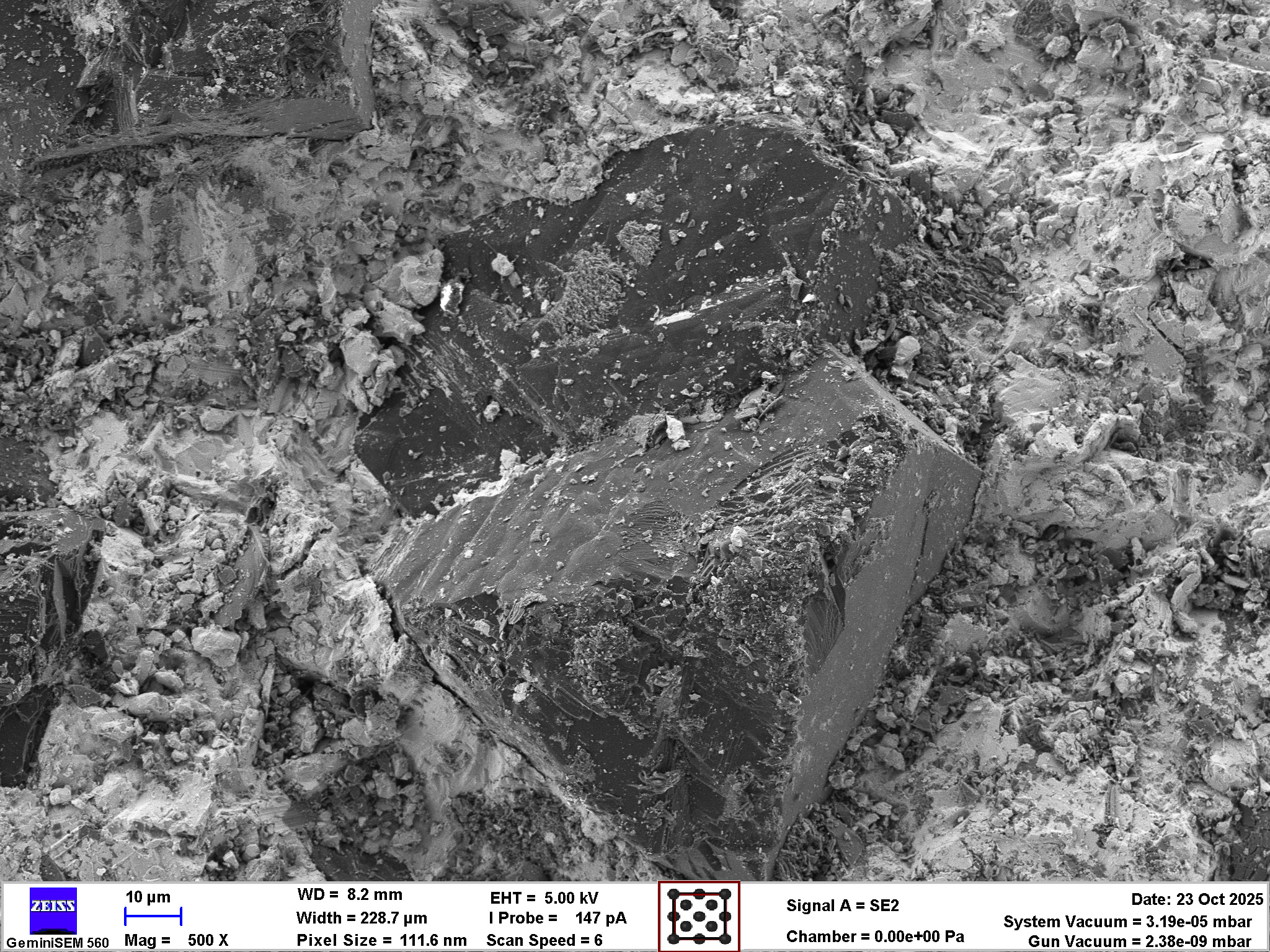
    SEM micrographs of the stone. Instrument: Zeiss GeminiSEM 560.

    In the SEM, we can see a standard mixed resin bond, but also large pockets, that seem to consist only of hard, similar sized grains. These pockets likely were “full” once, but lost the majority of their filling during dressing or cleaning of the stones. Inside the bubble shaped recession, one can make out many similar sized grains. I’m curious what these particles consist out of.

    Let’s look at the chemical composition! For this we are going to use an advanced SEM technique called EDS. If you want to know more about this, I’ve written extensively about SEM microanalysis here on this blog.

    EDS analysis of the stone. Instrument: Oxford Ultim Max  ∞ 40mm2 EDS sensor. Note that our EDS sensor doesn’t show elements lighter than boron.

    The EDS detector shows that the bubble particles are mostly silicon – some oxygen is visible as well. I would guess that it is hard particles of SiO2? Maybe some smaller SiC grains? The analysis is not fully concise here, it’s difficult to get the xray signal out of a pocket. A second location shows a lot of SiO2 particles, with a decent diamond concentration that tends to clump together. Overall, this stone is pretty badly mixed. Let’s check whether this impacts the final result!

    In order to evaluate the sharpening performance and material removal mode of this stone, a blade was sharpened with it. I am using a standardised testing procedure, read about it hereNevertheless, it’s 65 HRC M398, and sharpened to 17 DPS with resin bond diamond stones down to 10 µm. Afterwards, the tested stone is used, first in a back and forth movement until the surface becomes homogenous, and then alternating strokes (5-5-3-2) on each side, for a total of 20 strokes towards the apex per side. No pressure is applied but the weight of the apparatus.

    The edge is then analysed in the electron microscope for breakouts and morphological appearance.

    SEM micrographs of the edge finished with the KDTU stone. Instrument: Thermo Fischer PhenomXL SEM.

    I’m not super happy, but also not super disappointed with this edge. The apex itself is okay-ish formed, it shows some deeper grooves than I would expect at 14/10 µm, which likely stems from the larger particles. The surface of the bevel meanwhile looks really rough. Lot’s of small prows, burrs and smearing is visible. This typically shows on M398 when the stone abrasive is too soft – for example, natural stones and SiC / Al2O3 based stones show this effect a lot.

    In the optical microscope, this is confirmed: the surface is marred and slightly dull.

    Microscope pictures of the KDTU 14/10 diamond hybrid stone. Instrument: Leica EMSPIRA

    The stone itself is pleasant to use, with quite a bit of feedback. The edge got decently sharp, but nothing groundbreaking here. In my opinion, this is a mid-level stone that suffers mostly from the bad mixing, inhomogenous makeup and massive amounts of filler abrasives.

  • A brief study on sharpening stones – Part 46 – Dr. Marv’s Scientific Sharpening Stone – Ultracoarse (300 & 150 µm, Diamond, Resin)

    This is part of a series of blog posts – looking into the appearance and composition of commercially available sharpening stones. If you are interested in the previous episodes, check out the archive for them.

    If you have some suggestion on what I should look at next, or want to share your super secret DIY stones, I could be persuaded to open the bag of analytical devices… hit me up on Instagram under @marvgro for that.

    Disclaimer: I’m not for sale. Every review you see on this blog is bought with my own money. I have no affiliation to any manufacturer. This segment features a review on my own product, so it can be considered an advertisement in some countries. You are warned!

    Review

    Today’s sharpening stone is something I didn’t want to do. Like, really! I found what I considered the perfect solution for re-setting and even creating the bevel. The fantastic ATOMA F400 sharpening stone was my go-to-resource for setting the bevel and completely regrinding a blade. You might notice on my use of the past tense – it’s been replaced. And, to backtrace – not by something I particularly wanted to do – but I got asked a lot, so I tried and engineered and found a solution – proudly presenting the latest addition, the Dr. Marv Ultracoarse Scientific Sharpening Stones!

    I firmly believe that the correct “jump” in terms of grit progression is to half the size. While it is possible to do a larger jump, the time spend to remove the scratches or damages from the previous time often make using another stone quicker. Moreover, when the sharpening action on one stone takes takes too long, one is liable to press harder. With my current lineup of stones ranging from 80 to 0.1 µm, the logical choice was to choose something along the 150-160 µm range and another, even coarser stone at double that value. Let’s take a look at the raw material going into them:

    Particle metrics for the first batch of the ultracoarse set.

    I specifically choose a more crystalline (aka: blocky) grain for the 300 µm stone. 300 µm is massive – that’s already 0.3 mm, or 0.011″ – about 6 blonde hairs, side by side! By using a more blocky shape, the surface morphology left after the sharpening action is smoother. But because diamond is so unbelievably hard, it still cuts freely. The funny thing is: the markting buzzwords you read about “soft cutting” or “sharp edges” don’t really apply in what we are doing here. Science has long defined what a “sharp” cutting edge looks like in subtractive manufacturing: the rake angle, but also the relative tool sharpness (RTS) play a huge factor. Relative tool sharpness is defined as your uncut chip thickness, divided by your cutting edge radius. This means: if the chip is larger than your cutting edge radius, you get a RTS>1, which is typically meant as “good cutting”, with proper chip formation. At RTS around 1, your specific cutting energy typically increases – more effort is wasted on things like friction, rubbing, elastic and plastic deformations. At RTS much smaller than 1, you might even get into a “burnishing” range, where plastic deformation dominates. Now, the cutting edges we “employ” are not the shape of the grain – instead, you have to look at every edge, every crevice and every nook on the grain as a potential cutting edge. Therefore, the actual shape of the grain does not really change whether it’s soft cutting or hard cutting, but the shape may very well project itself on the blade we try to sharpen. My decision to use a blocky grade for the 300 µm stone thus does not change the way it cuts – it just improves the surface morphology creation.

    Let’s take a look at the stones:

    The very first set of Dr. Marv’s Scientific Sharpening Stones –

    The stones are REALLY green. That is because the diamond inside these stones is greenish in colour, and there’s no fillers or other additives in these stones besides the diamond.

    PLACEHOLDER: SEM pictures of broken through stones. Mea culpa, forgot to copy those. Will add these on monday or tuesday.

    These stones are designed to re-shape a bevel, help create one or rescue a ruined knife. They really move a lot of material! I’ve decided to expand my testing procedure with a 2nd steel.

    The first steel is Boehler M398. I absolutely love M398 – it polishes beautifully, has great edge retention and decent corrosion resistance. It contains quite a high carbide content, most noticeably in the form of Vanadium carbides.

    It is the steel I’ve used for all of my blog reviews so far – and has been hardened by my good friend and the heat treat virtuoso Roman Kasé to 65 HRC.

    New in future reviews is a more “common” steal with a commercial heat treatment. I’ve decided on NitroV – and bought a couple of Civivi Sendy knifes.

    NitroV is basically AEB-L, with 0.1 % Nitrogen added in. This makes it very comparable to one of the most used knife steels, and probably a steel (or very close!) that everyone of my avid readers has lying around, somewhere. I’ve decided on a commercial heat treatment, because I wanted to have an opposing data point to the custom heat treat M398 I typically use.

    The steel measured at 59-60 HRC, and chemical composition inside the SEM checks out to NitroV.

    In the following, I have sharpened both M398 and the NitroV blades with the new stones. My usual approach to sharpening comes to use here. They got used with oil.

    Let’s take a look at the edges from the 300 µm stone:

    SEM micrographs of the M398 edge – 300 µm stone. Instrument: Thermo Fischer PhenomXL SEM.

    SEM micrographs of the NitroV edge – 300 µm stone. Instrument: Thermo Fischer PhenomXL SEM.

    Honestly, when I started work on these stones, I expected these to be massive material hogs. And they are! The blade is just disappearing as you grind along. But the resulting apex is actually already pretty fine, there’s no massiv burr or prow formation, and the surface finish is not too bad. This checks out under the optical microscope, too:

    Optical micrographs of the M398 blade (first 3) and the NitroV blade (last picture) after sharpening with the 300 µm stone. Instrument: Leica Emspira

    In order to give you some sense of the speed, I’ve compiled some examples for you from my own use:

    150 micron stone: 1 min per side to get from beltground finish to 17DPS apex on REX121 (70 HRC)
    300 micron stone: 2 min on M398 (65 HRC) to change bevel angle from 17.5° to 17°
    300 micron stone: complete rework of the edge of a Civivi Sendy in Nitro V (60 HRC) in < 2 min

    Obviously, speed is something very subjective – it depends a lot on the steel used, your pressure and the condition of the stones. To me, this feels like the fastest ever resin stone I’ve used. The 300 µm feels faster than the ATOMA F400, but leaves a better finish. The 150 µm one feels pretty similar in terms of speed, but leaves a much nicer apex for me. Speaking about the 150 µm one, this is the apex created with it:

    SEM micrographs of the M398 edge – 150 µm stone. Instrument: Thermo Fischer PhenomXL SEM.

    SEM micrographs of the M398 edge – 150 µm stone. Instrument: Thermo Fischer PhenomXL SEM.

    Honestly, I’m stumped. This is a fantastic apex – and the surface is looking really good, while this is the “coarsest” stone I’ve had on this blog (with the exception of my 300 µm one!). This is a super nice result. I’ve been playing around with prototype stones in this grit range for quite some while, and they’ve been used to set the angle on most blades for my review for the past couple of months. The stone is super long lasting, super quick and… I absolutely love it.

    Optical micrographs of the M398 blade (first 2) and the NitroV blade (picture 3&4) after sharpening with the 150 µm stone. Instrument: Leica Emspira

    A word on their use: the stones are really agressive. And just like all non-EP stones, they loose grains. On these stones, with such a large diameter grain, this is more noticeable than on fine stones, as you can immediately spot these diamonds. I think I’ve managed to get a better grain retention going than most stones. Nevertheless, I would advise to either clean the loose abrasive very carefully from the blade – no pressure while wiping it down – or even flushing them off with some water or oil.

    This “review” feels a lot like an advertisement to me. Well, maybe because it is one, it is after all my own product. It is one I didn’t really want to make, and I’m very happy a couple of friends pushed me to pursue this. It’s exceptional, and the surprise in how good the performance is makes this even better. Thank you, dear reader for following my journey.

    The stones will be available in a very limited run in my webshop, beginning of February 2026.

  • A brief study on sharpening stones – Part 45 – PDTools Vitrified Diamond 40/28 µm (Diamond, Vitrified)

    This is part of a series of blog posts – looking into the appearance and composition of commercially available sharpening stones. If you are interested in the previous episodes, check out the archive for them.

    If you have some suggestion on what I should look at next, or want to share your super secret DIY stones, I could be persuaded to open the bag of analytical devices… hit me up on Instagram under @marvgro for that.

    Disclaimer: I’m not for sale. Every review you see on this blog is bought with my own money. I have no affiliation to any manufacturer.

    Review

    Today’s sharpening stone is the smaller grit brother of the last instalement in this series – the PDTools Vitrified Diamond in grain size 40/28 µm. Typically, this grit size gives nice, toothy edges – ideal for cooking knives, especially if reworked with a very fine diamond to further refine the apex. With so many parts of this “brief study”, one notices a pattern in my stone purchases: it’s either very coarse, a medium grained stone such as this one here, or a very fine one. I do this, because I am interested in how the manufacturers manage to deal with challenges such as grain retention, cost vs concentration considerations, but also agglomeration. I do not test full series of stones, because frankly: I purchase these stones with my own money; most stones see my blog review, and then are spending the rest of their life in a drawer and don’t get used.

    Onwards to the review of this vitrified diamond stone!

    Optical micrographs of the PDT Vitrified Diamond 40/28 stone. Instrument: Leica Emspira

    The optical micrographs are already very interesting. There’s definitely some much larger than expected grains in this stone – but also, quite a bit of diamond can be made out. This will be one interesting stone!

    SEM micrographs of the PDT Vitrified Diamond 40/28 stone. Instrument: Zeiss GeminiSEM 560.

    The view from the optical microscope is once again confirmed – between the diamond particles, which clump together a bit, are much larger grains visible. To me, the vitrified bond looks very similar to the one in the 100 micrometre stone review – not super high vitrification, with lots of filler particles. Seems like the same size particles was chosen for this finer stone.

    Let’s look at the chemical composition! For this we are going to use an advanced SEM technique called EDS. If you want to know more about this, I’ve written extensively about SEM microanalysis here on this blog.

    EDS analysis of the stone. Instrument: Oxford Ultim Max  ∞ 40mm2 EDS sensor. Note that our EDS sensor doesn’t show elements lighter than boron.

    The matrix is a standard vitrified bond, consisting of different oxides. The diamond is not as nicely distributed as in the coarser brother. It is quite difficult to mix powders well – here, we can find spots that are nearly empty of diamond, and others where it nearly clumps together. I find the addition of titanium once again quite curious – this probably gives the bond some tensile strength when used in CNC applications? Larger, hard oxide particles can also be easily spotted – these are several times larger than the diamond inside the stone.

    In order to evaluate the sharpening performance and material removal mode of this stone, a blade was sharpened with it. I am using a standardised testing procedure, read about it hereNevertheless, it’s 65 HRC M398, and sharpened to 17 DPS with resin bond diamond stones down to 10 µm. Afterwards, the tested stone is used, first in a back and forth movement until the surface becomes homogenous, and then alternating strokes (5-5-3-2) on each side, for a total of 20 strokes towards the apex per side. No pressure is applied but the weight of the apparatus.

    The edge is then analysed in the electron microscope for breakouts and morphological appearance.

    SEM micrographs of the edge finished with the PDT Vitrified Diamond 40/28 stone. Instrument: Thermo Fischer PhenomXL SEM.

    Uff. I’m not really sure what to say here. The bevel shows some deeper scratches, also some scratches are not very straight – this is typically the sign of a particle coming loose and rolling around. The real issue I find in the apex – just like with the coarse vitrified stone, we do not have a clearly defined, cut apex, and also not really a formed burr. Instead, the whole apex is pushed over – plastic deformation instead of material removal. This structure feels to the thumb like a burr – but actually is not, and will make subsequent, finer grit sharpening steps more difficult, as they will have to abrade more material. I’m once again a bit disappointed in this one – vitrified stones have a near-mythical reputation, and this one for sure lives up to the hype created by paid youtubers – something that feels like a burr is formed in very few strokes. At high magnifications, this turns out to not be a burr, but bending of the apex and some scratched bevel. This is once again shown in the optical pictures, which also reveal the massive amount of scratches on the blade:

    Optical micrographs of the blade sharpened with the PDT Vitrified diamond stone. Instrument: Leica Emspira

  • Sharpening Mechanisms – Part 1 – Katocut Nowi Pro

    This is the start of a new blog series, where I try out sharpening mechanisms. I’m not yet fully sure about the format – I will write about things that matter to me, such as build quality, capability to sharpen, but also very subjective things like how it feels to sharpen with this. If I was you, I would expect this to be a rare blog segment. The reviews will be independent from the manufacturer, without control over what I test or write. I am not paid nor do I receive anything from the manufacturer if you decide to buy one.

    If you make a sharpening device and you want me to test it, feel free to reach out.

    KATOCUT Nowi Pro

    This sharpening mechanism is made by the Austrian engineer Alexander Hackl. He operates an engineering company under the name KATOCUT. The exact model for this post is the “Nowi Pro Black Edition”, which at the time of this review retails for around 1600 Euro, including VAT.

    A close-up view of a Nowi PRO device featuring a black arm, attached to a sturdy base with an olive-green component, designed for precision tasks.

    The sharpening mechanism is based on what is typically called a “Bogdan” principle. This means the knife is held at the desired angle by fixing that degree of freedom, while leaving most other directions free to move. I’ll dig deeper into this later on, but basically this means the angle is not dependent on the knife geometry or the height of the sharpening stone – which is also a principle, much in contrast to guided rod sharpeners, where every point along the curve of the knife later is sharpened to the same, precise angle.

    Basic configuration to put the Katocut together with the clamping mechanism. And a very pretty custom Shard from Roman Kasé in Rex 121.

    The Katocut comes in a very high quality, solid case with a precise foam cutout. The baseplate is heavy, 8 mm thick steel that looks powder coated. The vertical rod is a 25 mm steel rod with a brushed finish. The arm is black anodised aluminium, with a (vertical) thickness of 20 (first link) and 14 mm (second link). The kit includes different mounting options, such as a clamp as well as a large and small magnet. The vertical guide rod features the angle-adjustable mechanism and there is a spring to adjust preload / weight compensation of the apparatus.

    A digital angle meter as well as all needed tools plus some food safe oil to lubricate the bearings and mechanism is included. No stone holder is included, but I would guess that you already own one, so that’s not a large issue.

    Build Quality

    The build quality of the black edition is very high. All parts are nicely anodised or coated, with no rack marks visible. The parts are made well – good straightness, no machining marks and homogeneous chamfers really create a high quality appearance. The 8 mm steel baseplate in combination with the 25 mm steel vertical rod give the whole mechanism quite some weight, further increasing the qualitative appearance. The threads are well machined, and everything fits together nicely without major play or struggles. The high price of the device is mirrored in the build quality, much more so than on other sharpening mechanisms. The machinist in me can only enjoy this!

    A couple of shots from the Nowi Pro.

    Working Principle

    Close-up of a mechanical arm joint and support structure, showcasing metal components and an adjustable lever.
    The angle adjustment mechanism. This constrains the angle of the blade, relative to a horizontal surface. Note the secondary swivel bearing below the mechanism.

    The idea behind any of these “Bogdan-Style” sharpeners is that a mechanism locks the angle of the blade, relative to the stone. On this system, this is achieved via a series of swivel joints and a threaded part of the rod. By setting a reference, for example via a digital level box, the angle can be adjusted very finely. Afterwards, the two screws are locked around the angular joint via supplied wrenches.

    Close-up of a digital level box displaying an angle of 17.0 degrees, mounted on a flat surface.
    Bevel box sitting on the parallel ground spline of a production Shard – if you have a fully ground blade, you need to compensate for the blade bevel angle.

    The reason this principle works so well can be put down to the principle of “constraints”. Every mechanism that moves has some degrees of freedom. Imagine a linear rail: you can move it back and forth, but not sideways or up and down. It is therefore constrained in 1 dimension.

    What happens here on the Nowi pro is similar – in that our system is also constrained – by the linkage joint shown above. This angular constraint makes sure that our knife only ever touches the stone at the angle we want:

    Illustration showing an angled tool in contact with a surface, with an angle 'a' indicated.

    This angle will stay constant, even if we rotate the vertical rod – it will just shift the contact point somewhere else along the stone! This is also true for moving the blade back and forth, or up and down – the angle won’t change, as it is constrained.

    Diagram illustrating the movement of a pivoting component above a flat surface, showing the angle 'a' and directional arrows to indicate motion.

    By arranging a second bearing, and this one after the constrained angle, it is possible to tip the blade from side to side – which will allow you to sharpen every point of the blade, even the tip, at this specific angle.

    A diagram showing a cutting tool in operation, illustrating the movement angle 'a' and the cutting edge against a workpiece surface.

    What this means is that the system is pretty robust in terms of knife geometry (length or width of the blade does not matter!), but also height of the sharpening stones. Where on other systems you have to fiddle and adjust if your sharpening stone progression has different heights, this system by design and constraints always has the same angle.

    Sharpening Process

    The use of this device is pretty straightforward: Clamp your knife, either in the supplied centering clamp, or attach it to one of the magnetic bases. The adjust the angle of the joint mechanism via the digital level box, make sure the screw nuts are tightened, and start sharpening!

    The sharpening action itself is – and I have to say this is of course very subjective – wonderful. This is what I think sharpening should feel like: relative movement between the blade and the sharpening stone, with no fiddling, no adjustments. Just you and the movement!

    When I started sharpening over a decade ago, I probably bought the same entry level stones everyone has lying around – some whetstones that you had to soak. The sharpening action on those was mostly defined by my skill – if I held the knife at the wrong angle, or wobbled, the result was a dull knife. But the freehand experience seems to scratch some primal itch, it is, for lack of better words how a knife should be sharpened.

    This mechanism fixes this issue in a big way: skill is not really needed here. I find this to be super true, as the first knife I ever sharpened on this mechanism probably was my sharpest knife to date… and it has only gotten more impressive with a little bit of practice. Check the action out below:

    Sharpening on the Nowi Pro – note the swivel mechanism of the clamp.

    Conclusion

    There is a lot of fantastic things about this mechanism. I absolutely love the way the sharpening movement happens here – if you ask me, this is how sharpening should be. It’s the freehand experience for those of us who lack the skills to sharpen freehand.

    The build quality and packaging of the device is stelar, as one would expect at this price point. Pair this device with a set of high quality benchstones (for example, Dr. Marv’s Scienitfic Benchstones), and you will have fantastic edges:

    A close-up of a sharp knife held above a black promotional card for Katocut sharpening systems, featuring a logo and an illustration of the sharpening device.
    A Kasé Shard (NitroX) sharpened on the Katocut Nowi Pro. Benchstones used: Dr. Marv’s Scientific Benchstones in 180 – 40 – 10 – 2.5 µm progression.

    I’ve had the Nowi since November of last year. It has replaced all other mechanisms and devices I own to sharpen my own knives. I don’t think I can give any higher praise.

    Moreover, this device will enable me to expand the blog reviews on sharpening stones towards benchstone sized ones – look out for some cool new reviews coming!

  • A brief study on sharpening stones – Part 44 – PDTools Diamond Vitrified 100 grit (Vitrified, Diamond)

    This is part of a series of blog posts – looking into the appearance and composition of commercially available sharpening stones. If you are interested in the previous episodes, check out the archive for them.

    If you have some suggestion on what I should look at next, or want to share your super secret DIY stones, I could be persuaded to open the bag of analytical devices… hit me up on Instagram under @marvgro for that.

    Disclaimer: I’m not for sale. Every review you see on this blog is bought with my own money. I have no affiliation to any manufacturer.

    Review

    Today’s sharpening stone is another PDT. After I was super disappointed in the much hyped CBN vitrified, and equally in the even more hyped silver, I thought: why not spend more of my money on another PDT stone. At least this time, it contains my favourite abrasive, diamond. Diamond is only metastable, meaning at around 680°C, it becomes graphite. Making a vitrified stone, where ceramic components need to at least achieve a glassy phase, below that temperature, is quite tricky. Let’s take a closer look!

    Optical micrographs of the PDT Vitrified diamond stone. Instrument: Leica Emspira

    These are some chunky diamonds! But also, lots of other particles we can peek here. This will be an interesting stone under the SEM!

    SEM micrographs of the stone. Instrument: Zeiss GeminiSEM 560.

    We can see lots of coarse, abrasive particles inside a brittle matrix. This looks a lot like their previous vitrified stone – but in this case, with diamond as the abrasive. One question here would be: did they manage to stop the diamond from becoming graphite? This is quite hard to detect, a first hint can be given by switching sensors back and forth. For this, I used the InLens detectors of our fantastic Zeiss SEM – switching the detected electron type, and also energy filtering. Especially the EsB sensor is very sensitive, graphite shows up in a different brightness than diamond.

    SEM micrographs of a diamond, comparing it’s appearance between the SE1 (InLens) and EsB (Backscatter InLens) detector. Looks very homogeneous! Instruments: Zeiss GeminiSEM 560.

    I did not find any difference here, even at lots of filtered energies – a good sign!

    Let’s look at the chemical composition! For this we are going to use an advanced SEM technique called EDS. If you want to know more about this, I’ve written extensively about SEM microanalysis here on this blog.

    EDS analysis of the stone. Instrument: Oxford Ultim Max  ∞ 40mm2 EDS sensor. Note that our EDS sensor doesn’t show elements lighter than boron.

    We can immediately identify the diamond, and also in a decent concentration and distribution! The matrix is a standard vitrified bond, consisting of different oxides. I find the addition of titanium quite curious – this probably gives the bond some tensile strength when used in CNC applications? I’m now very excited to try this out!

    In order to evaluate the sharpening performance and material removal mode of this stone, a blade was sharpened with it. I am using a standardised testing procedure, read about it hereNevertheless, it’s 65 HRC M398, and sharpened to 17 DPS with resin bond diamond stones down to 10 µm. Afterwards, the tested stone is used, first in a back and forth movement until the surface becomes homogenous, and then alternating strokes (5-5-3-2) on each side, for a total of 20 strokes towards the apex per side. No pressure is applied but the weight of the apparatus.

    The edge is then analysed in the electron microscope for breakouts and morphological appearance.

    SEM micrographs of the edge finished with the stone. Instrument: Thermo Fischer PhenomXL SEM.

    The stone itself feels ultra coarse. There’s a massive amount of vibration/feedback, and one can really see how it removes material. It also stinks like no tomorrow. This is something I find with a lot of eastern stones – I’m unsure what they do to these, and when I use them they have been thoroughly cleaned and survived high vacuum inside the SEM. Nevertheless, the stone quickly removed a lot of material. The hype about this stone is in some part understandable – after just a few stroks, one can feel something akin to a burr! Taking a closer look under the SEM, this “burr” is revealed not really as a burr, but as a massive, deformed apex. I generally sharpen without any pressure but the weight of the aparatus, and the whole bevel is bend at nearly 45°, forming a super wide apex of > 10 µm. Brittle spots where the matrix cracked and individual carbides are visible can be identified. I’d say that without a high resolution optical microscope, it can be easily mistaken for ultra quick burr formation. But what we typically look for in a burr – a properly formed apex, isn’t visible here. Instead, massive plastic deformation prevails, which will probably make it harder to achieve superior sharpness later in the process.

    I’m really disappointed – I was hoping for a long lasting, bevel setting coarse stone. My guess is that the very hard vitrified bond pushes against the steel matrix and thus mostly deforms and pushes the material.

    Moreover, the bevel shows very deep, coarse scratches. I think this could be an option if you are a knifemaker and really need to remove a lot of material before forming the first apex, but for every knife that already was sharpened before, I find this stone to be more of a “wreck your steel” than “prepare that bevel” solution.

    Optical micrographs of the bevel sharpened with the PDT Vitrified stone. Note the large breakouts and folded over bevel. Instrument: Leica EMSPIRA 3.

    Sharpening disclaimer: I use a standardised approach to sharpening, which basically follows how most manufacturer of guided systems tell you to use this system. I am very aware, that every stone could perform much better than this, in terms of sharpness, but I want a comparable approach. The sharpening segment mostly shows the material removal mechanism – is it burnishing? is it cutting? is the cutting pressure too high so that carbides crack? Is there massive burr or prow formation? The BESS value definitely doesn’t highlight the ultimate sharpening performance of the stone, but was an often requested information. Over time, this blog will show BESS values for different edge morphologies, but by the holy endmill – don’t read it as a „this is the max value this stone can achieve“. I would also suggest to familiarise yourself with the works of Immanuel Kant, it’s absurd I need to write such a disclaimer here.

  • A brief study on sharpening stones – Part 43 – Shapton Pro Ha-Nu-Korumaku 1000 Grit (Aluminiumoxide)

    This is part of a series of blog posts – looking into the appearance and composition of commercially available sharpening stones. If you are interested in the previous episodes, check out the archive for them.

    If you have some suggestion on what I should look at next, or want to share your super secret DIY stones, I could be persuaded to open the bag of analytical devices… hit me up on Instagram under @marvgro for that.

    Disclaimer: I’m not for sale. Every review you see on this blog is bought with my own money. I have no affiliation to any manufacturer.

    Review

    Today’s sharpening stone is a japanese whetstone – the Shapton Pro Ha-Nu-Korumaku at 1000 grit. It’s a coloured alumina oxide stone. Shapton has a stellar reputation in the sharpening world. The 1×6″ version I bought was purchased through a German online shop.

    Let’s take a look under the optical microscope:

    Optical micrographs of the stone. Instrument: Leica Emspira

    We can see some larger, very white particles in an orange matrix. The white particles are most likely the aluminium oxide – the purer, the whiter it becomes!

    SEM micrographs of the Shapton Pro stone. Instrument: Zeiss GeminiSEM 560.

    I’m not sure about you, but I am not surprised at this point! It’s exactly what one would expect: AO particles of the correct size in a hard, brittle matrix. This is not surprising, as it’s a japanese stone and they have a reputation for honesty and hihg quality products. I’m curious though, what the chemical composition is like!

    Let’s look at the chemical composition! For this we are going to use an advanced SEM technique called EDS. If you want to know more about this, I’ve written extensively about SEM microanalysis here on this blog.

    EDS analysis of the stone. Instrument: Oxford Ultim Max  ∞ 40mm2 EDS sensor. Note that our EDS sensor doesn’t show elements lighter than boron.

    The EDS analysis shows it’s a mix between different oxides – mostly Al2O3, MgO and to some lesser extend CaCO3 and SiO2. It’s quite tricky to make any oxide ceramic ultra pure, and probably also not needed for this stone. I think it’s therefore save to declare that it’s Al2O3 particles as the main abrasive, in a matrix of other, softer oxides that make up the bond design.

    In order to evaluate the sharpening performance and material removal mode of this stone, a blade was sharpened with it. I am using a standardised testing procedure, read about it hereNevertheless, it’s 65 HRC M398, and sharpened to 17 DPS with resin bond diamond stones down to 10 µm. Afterwards, the tested stone is used, first in a back and forth movement until the surface becomes homogenous, and then alternating strokes (5-5-3-2) on each side, for a total of 20 strokes towards the apex per side. No pressure is applied but the weight of the apparatus. As this is a water stone, I’ve used water instead of the typical oil.

    The edge is then analysed in the electron microscope for breakouts and morphological appearance.

    SEM micrographs of the edge finished with the stone. Instrument: Thermo Fischer PhenomXL SEM.

    The stone struggled quite a bit with the M398 steel I use for the tests. The apex was rounded over a little bit, and overall during use, it felt like the stone looses more than the steel edge I’m trying to sharpen. Moreover, some larger particles introduced pronounced scratches. Overall, I think the blade got noticeable duller due to the preparation with this stone. But from it’s composition, general well made quality, I would guess that this is an exceptional (and very affordable!) stone for less high-tech steels.

  • Musings about material removal – Part 5 – Dressing sharpening stones and inevitable contamination (continued…)

    TL;DR:

    Lemma: When flattening / dressing a sharpening stone, what’s the best approach to avoid contamination? Continuation from a previous post, expanding with other methods.

    Methodology:

    • Made some contamination free 10 µm resin diamond sharpening stones (identical to Dr. Marv’s Scientific sharpening stone)
    • Flattened 1 sample on a glass plate with toothpaste
    • Flattened 1 sample on an ATOMA F400 electroplated stone under running water
    • Flattened 1 sample on a SiC flattening Stone
    • Flattened 1 sample on a coarse resin stone (TSPROF Alpha)
    • Looked under the SEM for contamination – using a backscatter detector which shows elemental contrast and EDS, which identifies elements and thus nails contamination down.

    Results:

    • Flattening a resin stone on the ATOMA F400 works fantastically. Very fast, and because the japanese totally nailed their bond, it doesn’t seem to release any diamonds!
    • All other methods showed varying success. The SiC flattening stone proved completely unsuitable, leaving large tracks of SiC on the stone surface. The toothpaste left very little contamination, but was super slow in renewing the surface of the stone. The coarse resin stone left some particles, but worked.

    Actual Science and long version:

    Sharpening stones experience uneven wear. This is because they are inherently anisotropic in their composition, but also because we as humans use them inequally. Often, the end parts of the stone do not get used, as you do not want to fall “off the edge”. Moreover, different movements, pressures and just general wear sometimes require you to flatten, dress or renew a stone. For simplicity’s sake, I will from this point onwards call the process “dressing”, as it is the technical term. What you apply this to (renewing the surface, flattening the stone or actual dressing, e.g. creating a surface morphology suited to the application) is irrelevant, as the general mechanic is a 3 body abrasion on a flat surface. In the last instalment on this, we looked at popular choices. Since then, I’ve sharpened a lot of knives and used a lot of different sharpening stones. I’ve experimented with dressing and I think I found a wonderful solution, which I want to share here!

    Let’s take a look at the methods:

    I.) Toothpaste on a glass plate

    I’ve tried several “home methods” that could be considered abrasives. Something I had high hopes for, but didn’t work at all was salt – I thought some coarse salt, very lightly wetted, would probably abrade the soft matrix. Sadly, after a lot of rubbing it around, I didn’t see any change on the stone. Same with coffee grounds! The last thing I took a look at was toothpaste. I used a charcoal containing “whitening” one, as those have a high content of polishing particles in them. (Exact brand, without wanting to make advertisements for them: “Colgate Sensation White: Aktivkohle”)

    The toothpaste worked … kind off. Removal is very slow, and it takes a long time to remove even a bit of material. Nevertheless, it smells fresh and minty. That’s nice.

    Under the SEM, the surface looks like this:

    A black and white microscopic image showing a textured surface with intricate patterns and features, captured at 200x magnification.

    Because we are using the “BSD” sensor of the SEM, heavier elements appear with a lighter colour. We can make out a lot of particles here on this surface -but all “medium grey” ones are actually the diamond. A couple of small, lighter coloured ones are visible. Via the SEM’s EDS sensor, we can identify these:

    An electron microscopy image displaying a dark background with a blue crosshair over a specific spot, along with a data table detailing the elements Carbon, Oxygen, and Silicon, including their atomic and weight concentrations.

    These particles can be identified as “SiO2”, which actually is the abrasive of many toothpastes. I’m surprised that it’s pretty much the same size as the diamonds – but I guess 10 micrometre SiO2 means that it’s not yet ultrafine particulates, and still is small enough to not feel like a mouth of sand.

    SiO2 is hard enough to scratch martensite, so at finer stones, I wouldn’t advise to use toothpaste to prefer the surface. Nevertheless, it’s a gentle and smooth way to renew a resin stone and bring new diamonds to the front.

    II. ATOMA F400 under running water

    Yes – another EP stone! Last time I used a relatively cheap and low technology EP stone. There, we found larger diamonds, corresponding to the EP stone grain size. In the time since then, I’ve reviewed the ATOMA F400 as a sharpening stone – and was not only thrilled by it’s performance to set a bevel (still my favourite stone for this!), but also by the high-tech, super strong bond ATOMA employs. Because this bond is so strong, I tried dressing the resin probes with this one, to see whether it would hold the grain better. For this, I first took a piece of relatively soft stainless steel (cheap kitchen knife) and vigorously rubbed it over the stone’s surface for some minutes, under running water. This got rid of any “looser” particles. After this, I rubbed the sample specimen in a figure 8 movement directly under the stream of water.

    Let’s take a look at the SEM:

    A highly magnified scanning electron microscope image showing a textured surface with irregular patterns and details.

    We can see a smooth, regular surface. No foreign particles are visible in the BSD – and also no “dulled” or shattered diamond particles. Frankly, I don’t see any resin bond being strong enough that two diamonds can crush each other – and for me, this is the “premium” method to renew a resin stone, which is also what I’m using on my personal sharpening stones. It’s relatively affordable, wonderfully quick and leaves the sharpening stone at a smooth, low roughness. Because the ATOMA plates are very well made, the sharpening stones become ultra flat, too! At some point, it will feel like the stone gets “sucked” onto the ATOMA.

    The EDS analysis shows no foreign particles:

    A complete map illustrating elemental composition, showing a grey and brown textured surface with a data table below. The table lists elements such as Carbon and Oxygen along with their atomic concentrations, weight concentrations, and stoichiometric weight concentrations.

    III. SiC dressing block

    Very readily available, and dirt cheap are so called SiC dressing/flattening stones:

    A textured, dark grey rubber mat with a zigzag pattern, resting on a light grey surface.

    First, let us take a look at these under the SEM,because I’m curious what they actually are:

    An electron microscope image showing a textured surface, likely of a material sample, with irregular shapes and varying shades of grey.

    SEM micrograph of a “SiC flattening stone”. Instrument: Thermo Fischer PhenomXL

    This is pretty cool! Looks like super large, sintered and slightly fused SiC particles, with lots of porosity in between. EDS analysis only showed Si and C – so this really is what the label says.

    A larger excerpt (stitched image of about 5×4 mm):

    Microscopic view of a textured surface showcasing irregular, jagged patterns and numerous porous holes.

    Dressing on this one is QUICK. Like, this thing is a file. I used it under running, warm water. Unfortunately, in the SEM, but also to the naked eye, brown streaks are visible after a short amount of dressing:

    A high-magnification electron microscope image showing a textured surface with intricate patterns and details.

    SEM micrograph of the SiC flattening stone “dressed” surface. Do note the angled, bright coloured streaks which are SiC.

    In the SEM, these are immediately visible as light coloured, heavier element particles. EDS analysis shows that this is SiC which rubbed of onto the diamond stone surface:

    A detailed map image displaying a microstructure with varying textures, accompanied by a table listing elements carbon, oxygen, and silicon, their atomic and weight concentrations, and stoichiometry.

    Detail of the streaks:

    A dark microscope image of silicon, displaying a textured surface with scattered light reflections and measurement indicators at the bottom.

    EDS showing the Si channel, visible all over the sample. Instrument: Thermo Fischer PhenomXL.

    IV. Coarse resin stone

    A good sharpening contact and fantastic customer told me he uses an old resin stone to dress his stones. I was curious whether this would loose some particles, and tried it out myself. For this, I used a TSPROF alpha 120 µm stone – because it is very coarse, resin based and I’m not a particular fan.

    Scanning electron microscope image showing a high magnification view of a textured surface with irregular patterns and granularity.

    This showed larger, bright particles in the SEM. EDS analysis:

    A microscopic image showing a spot analysis with parameters indicated, including FW, mode, point, and detector settings. Below the image, there is a table listing elements (Carbon, Oxygen, Sodium, Aluminum) along with their atomic percentages, weight percentages, oxide symbols, and stoichiometric weight concentrations.

    We can see some Sodium and aluminium in these particles – and if we compare this to the composition of the TSPROF stone:

    An elemental map displaying various material compositions, with colour-coded elements shown in a grid format. The main image depicts a mix of green, pink, and red areas, indicating different chemical distributions.

    So – while it worked surprisingly well, and quickly created a relatively smooth surface, we also abraded the softer fillers of this stone into the diamond resin stone sample. I would say this is a decent method, if you have a diamond resin stone which contains some filler – the particles seem to be in a similar size to the stones grit size, although this could also be just happenstance. Overall, I think this is an “okay” way to dress a stone, but falls short of the ATOMA performance.

    Final conclusion:

    I originally planned (and had some designs!) for a contamination free dressing device to offer to similar enthusiasts as I am. But for my personal sharpening stones, I think the ATOMA F400 is a fantastic choice in dressing them. It’s relatively affordable, super quick, smooth surface and lasts quite a long time. I was able to dress about 30 sharpening stones before it became a little bit slower. In the SEM, I wasn’t able to find any foreign particles, or larger loose diamonds. Customers have reported great success in dressing even fine, ultra pure stones with this. As I personally also use an ATOMA to set bevels, I’ve just created a rotation – first use them to sharpen, and when they become slightly dull, they get relegated to “dressing duties”.

    If you have any input on methods for a 3rd instalment of “dressing methods, please reach out to me!

  • A brief study on sharpening stones – Part 42 –  PDTools Silver 160 Grit (125/100 µm, CBN, Metal Bond)

    A brief study on sharpening stones – Part 42 – PDTools Silver 160 Grit (125/100 µm, CBN, Metal Bond)

    This is part of a series of blog posts – looking into the appearance and composition of commercially available sharpening stones. If you are interested in the previous episodes, check out the archive for them.

    If you have some suggestion on what I should look at next, or want to share your super secret DIY stones, I could be persuaded to open the bag of analytical devices… hit me up on Instagram under @marvgro for that.

    Disclaimer: I’m not for sale. Every review you see on this blog is bought with my own money. I have no affiliation to any manufacturer.

    Review

    Today’s sharpening stone is the coarser brother of the PDTools 650 grit silver we’ve analysed before. According to the manufacturer, the bond is a “hybrid vitrified” one – we’ve proven on the 650 grit that it’s mostly a markting buzz word bingo, as it’s just a very hard metal bond. Let’s dive into the coarser one:

    Optical micrographs of the PDT Silver 160 grit stone. Instrument: Leica Emspira

    The lovely thing about LARGE abrasive media is – they are easy to identify under an optical microscope! The 160 grit stone has very visible CBN particles. They are pretty evenly distributed and blocky in their shape. In between the CBN grains, a silver bond is visible.

    Let’s focus on this stone under the SEM:

    SEM micrographs of the PDT Silver 160 grit stone. Instrument: Zeiss GeminiSEM 560.

    The view from the optical microscope is confirmed – we have large, blocky CBN grains inside a metal bond. The metal bond looks pretty regular and homogeneous. There are smaller abrasive particles interspersed between the gigantic (well, at least in the SEM…) CBN grains.

    Let’s look at the chemical composition! For this we are going to use an advanced SEM technique called EDS. If you want to know more about this, I’ve written extensively about SEM microanalysis here on this blog.

    EDS analysis of the PDT Silver 160 grit stone. Instrument: Oxford Ultim Max  ∞ 40mm2 EDS sensor. Note that our EDS sensor doesn’t show elements lighter than boron.

    Once again, we are shown a wonderful colourscape of different elements! The CBN grains are easily identified as such. The matrix consists once again out of copper, tin and iron. Moreover, a large number of decently fine SiO2 and SiC abrasive particles can be seen. SiC is often added as a filler to grinding tools to make them harder. This is in tune with the statement that these will last nearly forever! One can also make out some Al2O3 particles as well as trace elements. Overall, this is a very complex bond with lots of filler particles. I’m not a huge fan of fillers – I personally prefer to get more superabrasive!

    In order to evaluate the sharpening performance and material removal mode of this stone, a blade was sharpened with it. I am using a standardised testing procedure, read about it hereNevertheless, it’s 65 HRC M398, and sharpened to 17 DPS with resin bond diamond stones down to 10 µm. Afterwards, the tested stone is used, first in a back and forth movement until the surface becomes homogenous, and then alternating strokes (5-5-3-2) on each side, for a total of 20 strokes towards the apex per side. No pressure is applied but the weight of the apparatus.

    The edge is then analysed in the electron microscope for breakouts and morphological appearance.

    SEM micrographs of the edge finished with the PDT Silver 160 grit stone. Instrument: Thermo Fischer PhenomXL SEM.

    This sharpening stone is for sure a very coarse one! We are left with a ragged, wavy and “teethy” edge. The teeth are spaced apart about as far as the CBN grains are wide. This goes hand in hand with the feeling that this stone works like a file – quick material removal, with a coarse finish. Unfortunately, there is also a lot of cracking happening near the apex. The very hard bond most likely creates a lot of pressure that introduces these damages.

    Optical micrographs of the sharpened edge. Instrument: Leica Emspira

    Overall, this is probably the coarsest and roughest finish on a bevel I’ve had so far on this blog. Even the very coarse TSPROF alpha is not at this level. This stone is a decent choice if you need to remove a lot of material, fast. Nevertheless, it’s still slower than my favourite EP stone – the ATOMA, and leaves you with a higher degree of damages near the apex, that subsequent stones need to remedy.

    I don’t detest this stone – but I think there are better choices out there if you need a really coarse rework stone, EP stones being at the very front of that list!

    Sharpening disclaimer: I use a standardised approach to sharpening, which basically follows how most manufacturer of guided systems tell you to use this system. I am very aware, that every stone could perform much better than this, in terms of sharpness, but I want a comparable approach. The sharpening segment mostly shows the material removal mechanism – is it burnishing? is it cutting? is the cutting pressure too high so that carbides crack? Is there massive burr or prow formation? The BESS value definitely doesn’t highlight the ultimate sharpening performance of the stone, but was an often requested information. Over time, this blog will show BESS values for different edge morphologies, but by the holy endmill – don’t read it as a „this is the max value this stone can achieve“. I would also suggest to familiarise yourself with the works of Immanuel Kant, it’s absurd I need to write such a disclaimer here.

  • A brief study on sharpening stones – Part 41 – Nanohone (10 µm, Diamond)

    This is part of a series of blog posts – looking into the appearance and composition of commercially available sharpening stones. If you are interested in the previous episodes, check out the archive for them.

    If you have some suggestion on what I should look at next, or want to share your super secret DIY stones, I could be persuaded to open the bag of analytical devices… hit me up on Instagram under @marvgro for that.

    Disclaimer: I’m not for sale. Every review you see on this blog is bought with my own money. I have no affiliation to any manufacturer.

    Review

    Today’s sharpening stone is something quite special – a structured stone! Structuring grinding media is a relatively “novel” thing, in terms of many recent research endeavours. In my day job, this would be called “engineered grinding wheels”, EGW – and typically has massive improvements in terms of cutting pressure, cooling behaviour and swarf transport. Nanohone do 3D printed (yes! and apparently FDM printed?) sharpening stones, where the sharpening media is embedded into the filament. Thus, they are able to structure the stone surface. Let’s take a look under the microscope:

    Optical micrographs of the Nanohone 10 µm stone. Instrument: Leica Emspira

    If you excuse my choice of words – WILD! I did not expect this. As a side note – the anodised blank is absolutely top notch quality. Freeform fillets and rounded, very nicely anodised – this is probably the fanciest aluminium blank I have come across yet.

    Let’s take a closer look under the SEM. Because the filament is very non conductive, we need to image in modes that allow for lower charge up:

    SEM micrographs of the stone. Instrument: Zeiss GeminiSEM 560.

    Quite wild! We can see a lot of macro-structures here – not sure where they stem from! If one zooms in a lot, the diamonds become apparent in a decent distribution.

    Let’s look at the chemical composition! For this we are going to use an advanced SEM technique called EDS. If you want to know more about this, I’ve written extensively about SEM microanalysis here on this blog.

    EDS analysis of the stone. Instrument: Oxford Ultim Max  ∞ 40mm2 EDS sensor. Note that our EDS sensor doesn’t show elements lighter than boron.

    Pretty much what one would expect from a simple thermoplast – this is filament and diamond, and not much else. The diamond is very nicely distributed, but not in very high concentration. I would guess that a higher concentration would wreck absolute havoc on their 3D printer nozzles…

    In order to evaluate the sharpening performance and material removal mode of this stone, a blade was sharpened with it. I am using a standardised testing procedure, read about it hereNevertheless, it’s 65 HRC M398, and sharpened to 17 DPS with resin bond diamond stones down to 5 µm. Afterwards, the tested stone is used, first in a back and forth movement until the surface becomes homogenous, and then alternating strokes (5-5-3-2) on each side, for a total of 20 strokes towards the apex per side. No pressure is applied but the weight of the apparatus.

    The edge is then analysed in the electron microscope for breakouts and morphological appearance.

    SEM micrographs of the edge finished with the stone. Instrument: Thermo Fischer PhenomXL SEM.

    Trying out this stone was…a bit disappointing. It felt super slow, like rubbing a piece of 3D printed plastic across the bevel. Probably, because that’s what it’s doing. After an extensive amount of rubbing, some swarf was visible – and some micro scratches started appearing on the blade. I would guess that both the lower surface area, but also the low concentration do not really help with the pursuit of a fantastic cutting edge. The final result is frankly like a slightly ragged and worn down edge from my pre-preparation. It got noticeably duller and less keen than my 5 µm finish I did in preparation. Under the optical microscope, larger breakouts and dimples were visible at the apex (compare below).

    I’m not sure what to make of this. Their approach is novel, probably very difficult to achieve (mixing their own filament with a lot of abrasives?), it looks cool and is produced in a superb craftmanship. It’s just…after the first 20 strokes of this stone, I was wondering whether it works at all, and it didn’t get any better. With a much higher concentration, and no structuring, this could be a good sharpening stone, but then their unique selling point is kind of gone. Overall, I don’t think I’ll pick up this stone again.

    Optical micrographs of the blade finished with the nanohone stone. Instrument: Leica Emspira

    Sharpening disclaimer: I use a standardised approach to sharpening, which basically follows how most manufacturer of guided systems tell you to use this system. I am very aware, that every stone could perform much better than this, in terms of sharpness, but I want a comparable approach. The sharpening segment mostly shows the material removal mechanism – is it burnishing? is it cutting? is the cutting pressure too high so that carbides crack? Is there massive burr or prow formation? The BESS value definitely doesn’t highlight the ultimate sharpening performance of the stone, but was an often requested information. Over time, this blog will show BESS values for different edge morphologies, but by the holy endmill – don’t read it as a „this is the max value this stone can achieve“. I would also suggest to familiarise yourself with the works of Immanuel Kant, it’s absurd I need to write such a disclaimer here.

  • A brief study on sharpening stones – Part 40 – PDT Expert Pro 7/5 (diamond, resin)

    This is part of a series of blog posts – looking into the appearance and composition of commercially available sharpening stones. If you are interested in the previous episodes, check out the archive for them.

    If you have some suggestion on what I should look at next, or want to share your super secret DIY stones, I could be persuaded to open the bag of analytical devices… hit me up on Instagram under @marvgro for that.

    Disclaimer: I’m not for sale. Every review you see on this blog is bought with my own money. I have no affiliation to any manufacturer.

    Review

    Today’s sharpening stone is another PDTools sharpening stone. It seems like they have unlimited R&D and are publishing a new best stone every week, so I’m barely able to keep up with the reviews on these. Today’s stone is their high end resin stone, which according to the manufacturer has a “resin-metal bond, ideal to produce a perfect cutting edge”. Let’s take a look under the microscope:

    Optical micrographs of the stone. Instrument: Leica Emspira

    The sharpening stone has some earth, copper like colour to it. At higher magnifications, larger particles and some inhomogeneities are visible. This will be one interesting stone under the SEM!

    SEM micrographs of the stone. Instrument: Zeiss GeminiSEM 560.

    The inhomogeneous look under the optical microscope is further confirmed in the SEM. We can detect a clear resin bond – to me, it looks to be mostly phenolic resin based (starting from a powder which is then heated to create the matrix), with lots of metal powders, but also much larger, hard abrasive particles in it. Exceptionally large, hard grains can be made out that are multiple times larger than the stated abrasive size. This typically points towards either poor abrasive hygiene in manufacturing or the “fortification” of a bond by adding filler particles – and SiC typically has a fantastic bonding behaviour with phenolic resins, making these much harder and tougher.

    Let’s look at the chemical composition! For this we are going to use an advanced SEM technique called EDS. If you want to know more about this, I’ve written extensively about SEM microanalysis here on this blog.

    EDS analysis of the stone. Instrument: Oxford Ultim Max  ∞ 40mm2 EDS sensor. Note that our EDS sensor doesn’t show elements lighter than boron.

    This is one colourful EDS analysis! Wonderful. Let’s dig deeper: First, we can easily identify the diamond. It’s shown in red colour (Carbon, C) and is distributed in small nests of agglomeration. Moreover, the large, massive particles are most likely SiC (large Si peaks), and we can see lots of metal particles (mostly copper ), which is typically added to CNC tools as heat-conducting filler particles. I’m a bit stumped by the Bismuth we can find here in decent quantities. Bismuth is not used a lot in industry. It has poor heat conductivity and is very brittle, so I don’t really see the appeal to add it to a grinding bond. Sometimes, it is a byproduct of copper production, but it is also very heavy (density similar to lead). Maybe it was added to give the stones more weight and create a more premium haptic feel? I am unsure. If you know more than me, I’d love to hear your thoughts!

    In order to evaluate the sharpening performance and material removal mode of this stone, a blade was sharpened with it. I am using a standardised testing procedure, read about it hereNevertheless, it’s 65 HRC M398, and sharpened to 17 DPS with resin bond diamond stones down to 10 µm. Afterwards, the tested stone is used, first in a back and forth movement until the surface becomes homogenous, and then alternating strokes (5-5-3-2) on each side, for a total of 20 strokes from the spinde towards the apex (edge trailing) per side. No pressure is applied but the weight of the apparatus.

    The edge is then analysed in the electron microscope for breakouts and morphological appearance.

    SEM micrographs of the edge finished with the stone. Instrument: Thermo Fischer PhenomXL SEM.

    The stone has quite a bit of haptic feedback. This probably stems from the much larger SiC particles in it. The cutting edge is okay. Some waviness to the apex is detectable, as well as some rounding of the edge. Some smearing and burnished pro formation is visible closer to the apex. There is very little detectable burr. This is a standard resin finish and expected from a resin stone that contains lots of fillers.

    Overall, I found the stone rather slow in it’s work. A perfect or even near perfect mirror was hard to achieve, because it constantly creates scratches and imperfections, likely from the large, hard particles in it. I’m a bit spooked by the composition of the stone, did not expect Bismuth in it. Once again, if you have any insight into why this is – please reach out!